Kia’s next electric van breaks cover! Bigger PV7 shapes up for Australia to battle Ford E-Transit, Farizon SuperVan, Renault Master E-Tech, LDV edeliver9 and Mercedes-Benz eSprinter
Kia has given us our first look at the new PV7 electric van ahead of its September world premiere, with the bigger brother to the PV5 expected to eventually join the Korean brand’s expanding Australian commercial vehicle line-up.
The PV7 is the second model in Kia’s new dedicated Platform Beyond Vehicle (PBV) family and will make its global debut at the IAA Transportation commercial vehicle show in Hannover, Germany, on September 14.
Kia is keeping most of the important technical details under wraps until then, but has confirmed the PV7 will be larger and more capable than the PV5 and move its electric PBV range more seriously into the light-commercial vehicle market.
READ MORE: New price leader! Kia PV5 Passenger electric people mover incoming with seven seats and long range battery
READ MORE: 2026 Kia PV5 Cargo Review: Funky van takes on Toyota Hiace, Hyundai Staria Load and Ford Transit with compelling EV drivetrain
READ MORE: Confirmed: Radical electric Kia PV5 people mover and cargo van coming to Australia. Ford Transit and Toyota HiAce fighter will make local debut this month
READ MORE: All-new electric Kia PV5 is a gamechanger in the world of vans with its advanced tech and interchangeable rear body
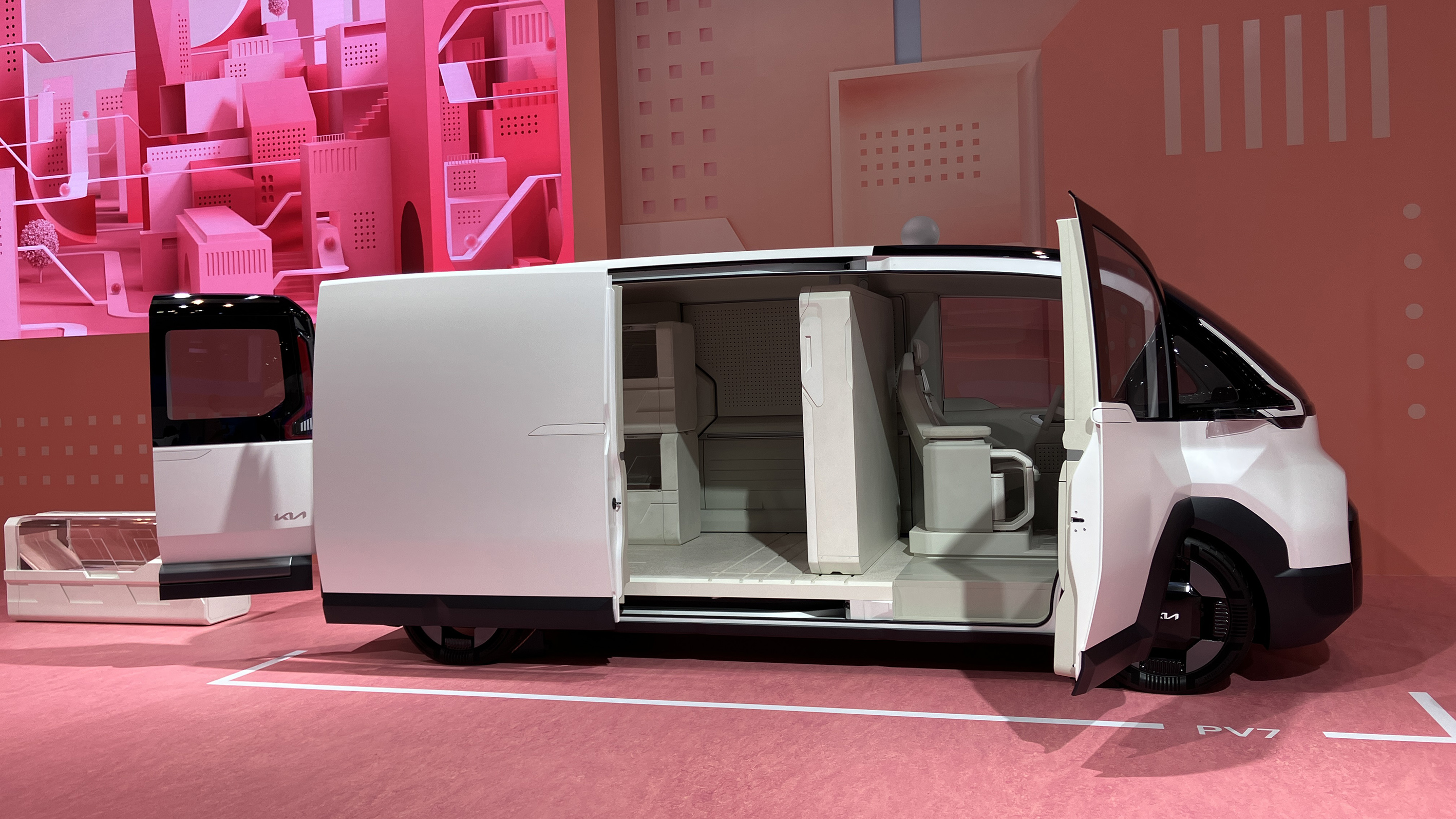
The teaster shots suggest both can and people-mover versions of the PV7 will be offered.
The PV7 van should be a logical rival for the larger electric vans already on sale or arriving in Australia, including the $89,990 plus on-road costs starting price Ford E-Transit, $62,990 Farizon SuperVan, $77,990 Renault Master E-Tech, $116,537 LDV eDeliver 9 and $104,864 Mercedes-Benz eSprinter.
The PV7 has yet to be officially confirmed for Australia, but is expected to follow the smaller PV5 into local showrooms as Kia expands its commercial vehicle presence beyond the diesel-powered Tasman ute.
More detail on Australian prospects and timing is likely to emerge when the PV7 is fully revealed at IAA Transportation.
The PV5 Cargo has already launched locally priced from $55,990 plus on-road costs, equipped with a 71.2kWh battery, 120kW/250Nm front-mounted electric motor and claimed 416km WLTP driving range. It offers 4420 litres of cargo capacity and a maximum 740kg payload.
The seven-seat PV5 Passenger is also headed to Australia in the final quarter of 2026, extending the PBV family beyond its initial commercial-van role.
But the PV7 will be a substantially bigger proposition. Kia says it will provide “increased space and capability beyond the PV5” and cater for a broader range of commercial and lifestyle applications.

The first official teaser images reveal a large, bluff one-box van with a very short bonnet, expansive windscreen and almost vertical rear body.
There are obvious visual links to the PV5, including the distinctive vertical lighting signatures at each end, although the PV7 has a more substantial and conventional commercial-van stance.
Kia has also deliberately shown the PV7 in different scenarios, including work and lifestyle applications, suggesting the range will eventually extend beyond a straightforward cargo van.
That fits with Kia’s broader PBV strategy, under which common electric vehicle architecture can support multiple body configurations and applications.
Like the PV5, the PV7 is based on Kia’s dedicated E-GMP.S architecture, which was developed specifically for the PBV family rather than being adapted from one of the brand’s conventional passenger EVs. Kia says future PV7 derivatives will further broaden its business mobility range.
No battery capacity, motor outputs, driving range, payload, cargo volume or charging specifications have yet been announced.

Those numbers will be particularly important because the PV7 will be competing in a class where carrying capacity and usable loaded driving range can be more important to fleet buyers than outright performance.
For comparison, the incoming Renault Master E-Tech combines an 87kWh battery with a 105kW/300Nm electric motor and offers up to 409km of WLTP range, while the Ford E-Transit produces 198kW and 430Nm.
Kia is also using IAA Transportation to demonstrate how far its broader PBV program can stretch, with multiple PV5 derivatives scheduled to appear alongside the production PV7.