Home EV charging explained: Everything you need to know
One of the biggest benefits of owning an electric vehicle is being able to charge it at home.
Instead of regularly visiting a petrol station, many EV owners simply plug their car in when they get home and wake up with plenty of charge for the next day’s driving.
But do you need an expensive EV charger? How long does home charging take? And what’s the difference between plugging into a normal powerpoint and installing a wallbox?
Here’s what you need to know.
How does home EV charging work?
EVs store DC electricity in their batteries, while the electricity supplied to Australian homes is AC, or alternating current.
When you charge an EV at home, you’re therefore using AC charging. The car’s onboard charger converts that electricity so it can be stored in the battery.
Public fast chargers generally use DC charging and can deliver electricity much more quickly.
For home charging, though, AC is what matters.
And there are two main ways of doing it:
- A regular household powerpoint, or
- A dedicated EV wallbox.
Can I charge an EV from a normal powerpoint?
Absolutely, a regular Australian household powerpoint can charge an EV – and here at the EV Central office we’ve done that plenty of times.
It typically supplies around 2.3kW of power, with slightly less ultimately reaching the battery once charging losses are taken into account.
That isn’t particularly fast, but it can be more useful than it initially sounds.
As a rough guide, a normal powerpoint can add around 10km of driving range per hour, although the exact amount depends on the efficiency of the vehicle.
Leave it plugged in for 10 hours overnight and you could potentially add around 100km of range.
If you normally travel less than that each day, a standard powerpoint may be all you need.
How long would a full charge take?
That’s where a normal powerpoint starts looking slow.
A 60kWh EV battery could take roughly 30 hours to charge from close to empty using a household outlet.
A much larger 100kWh battery could take around 50 hours.
But those numbers can be misleading.
Most owners aren’t arriving home every night with a completely empty battery.
If you’ve driven 40km during the day, you’re only replacing the electricity used to travel those 40km.
That’s why someone with relatively modest daily driving – around 100km per day – can potentially live quite happily charging from a standard outlet overnight.
So why install a wallbox?
That’s not to say a wallbox charger – a dedicated EV charging unit connected directly to your home’s electricity supply – doesn’t make sense.
It essentially provides convenience and speed, allowing you to plug in less frequently and potentially charge quicker on off-peak electricity (or using solar from your rooftop).
A common single-phase wallbox can provide about 7.4kW, making it around three times faster than a normal household powerpoint.
For an EV with a 60kWh battery, a near-empty to full charge would take something approaching 10 hours once charging losses are considered.
In other words: overnight.
For many EV owners, that’s the sweet spot.
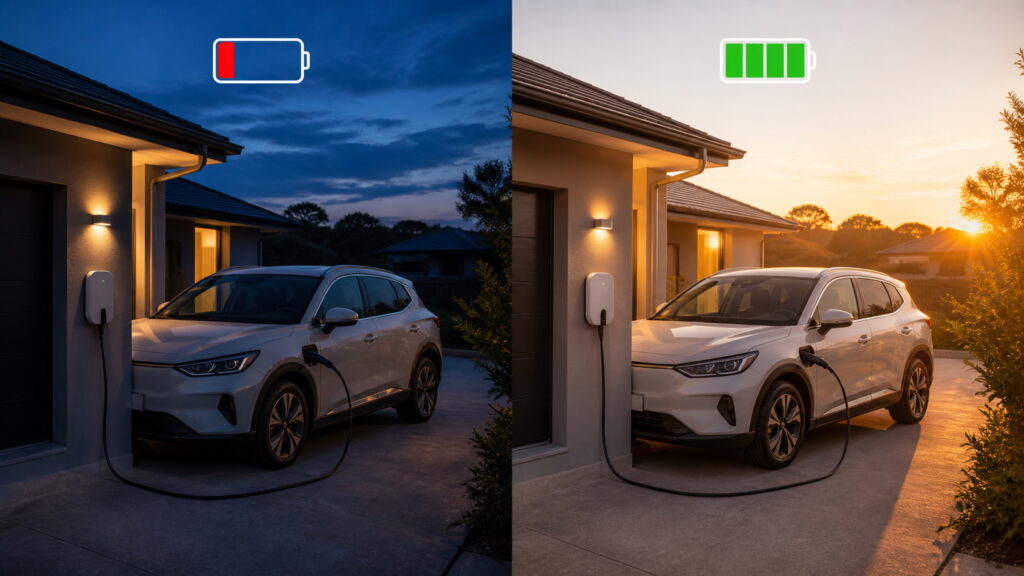
Plug the car in when you get home and it’s ready the following morning.
Do I need three-phase charging?
Probably not.
Many Australian houses have single-phase electricity, and a 7.4kW wallbox will be more than adequate for many EV owners.
If your property has three-phase power, you may be able to install an 11kW or 22kW charger.
That can significantly reduce charging times – but ask yourself whether you actually need the additional speed.
If the car is going to sit in your garage from 8pm until 7am anyway, there may be little practical difference between finishing the charge at 1am and finishing it at 5am.
Check what your car can accept
This is important.
The wallbox determines how much electricity can be supplied, but the car determines how much electricity it will accept.
Some EVs can accept three-phase AC charging while others are limited to single phase.
So installing the most powerful charger available doesn’t guarantee your particular EV will charge at that speed.
Before choosing a wallbox, check the vehicle’s maximum AC charging capability.
Can a charger be too powerful for my EV?
You don’t need to worry about damaging your car by connecting it to a charger capable of supplying more power than the vehicle can accept.
The EV controls how much electricity it takes.
So if the charger can provide more power than the car’s onboard charger can handle, the vehicle simply limits the charging rate.
That means the bigger question isn’t whether a powerful charger is safe – it’s whether paying for the extra capability provides any benefit.
How much does a home wallbox cost?
Wallbox hardware varies considerably in price and features, with basic units available for less than $1000.
Installation is an additional cost and will depend on your home.
Things such as the location of your switchboard, distance to the garage or parking space, available electrical capacity and whether additional electrical work is required can all affect the installation price.
A licensed electrician should assess the property and install the charger.
Before buying a wallbox, it can be worth getting an installation quote so you understand the total cost rather than just the price of the charger itself.
What plug does my EV need?
All new EVs sold in Australia use a Type 2 connection for AC charging.
That means a properly configured Type 2 home wallbox isn’t tied to one particular brand of EV.
The same home charger can potentially charge vehicles from Tesla, BYD, Kia, Hyundai, Toyota, Volvo, Porsche and other manufacturers.
That’s useful if you change cars later or have two different EVs in the household.
What about charging losses?
Not every kilowatt-hour of electricity leaving your house ends up stored in the battery.
Some energy is lost during the charging process, often as heat.
As a rough guide, charging losses can be around 10-15 percent, although the exact amount varies.
So putting 60kWh into a battery may require more than 60kWh to be drawn from your electricity supply.
That’s worth remembering when calculating charging times and running costs.
Can solar charge my EV?
Absolutely – and it’s one of the attractions of combining an EV with rooftop solar.
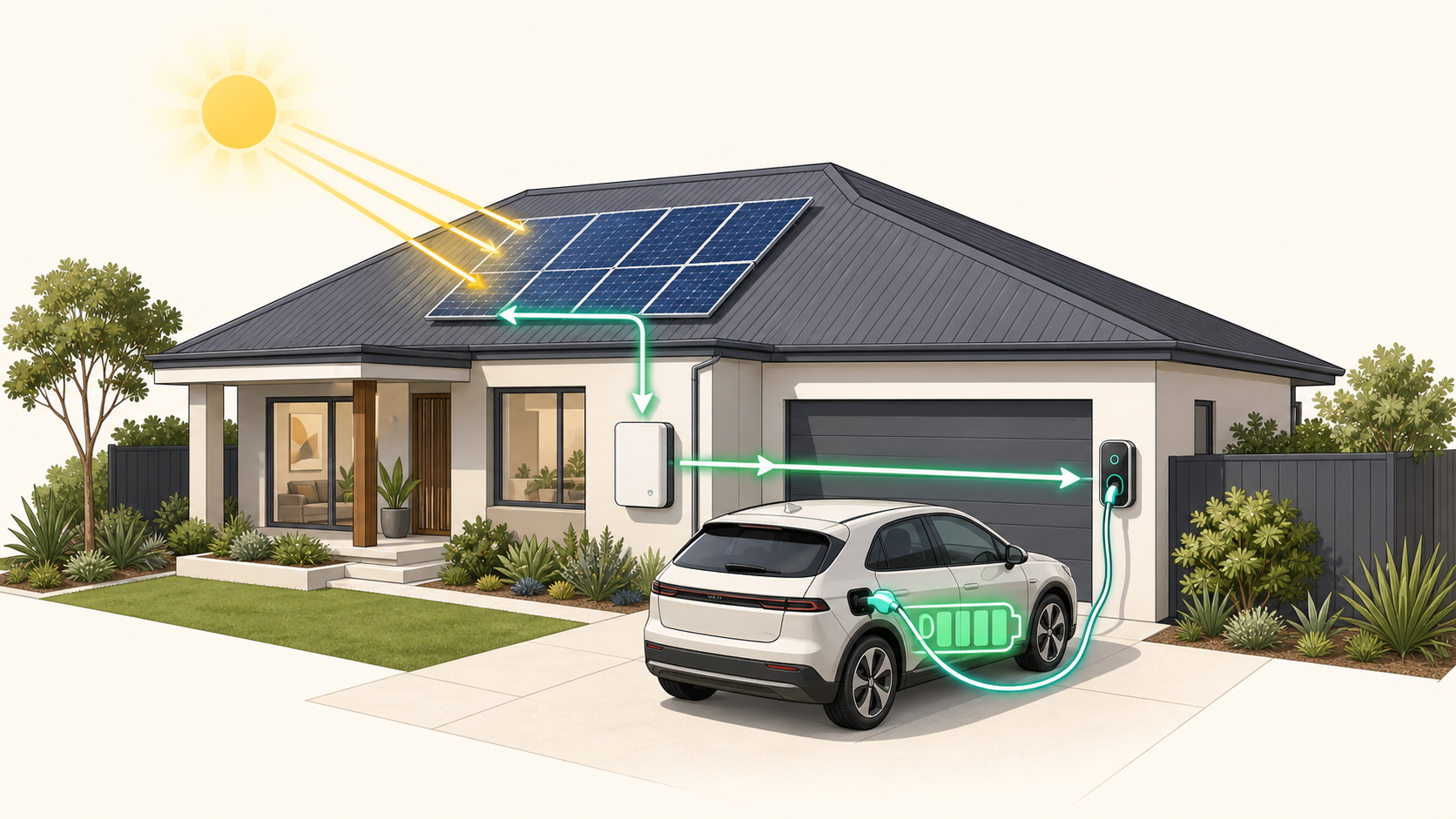
If your vehicle is home during daylight hours, surplus solar generation can potentially be used to charge the car rather than exporting that electricity to the grid.
Some smarter wallboxes can monitor the home’s solar generation and adjust the vehicle’s charging rate so it preferentially uses surplus solar electricity.
A home battery can also allow solar generated during the day to be used later, although adding a battery purely for EV charging can be an expensive solution.
Look at your electricity plan
Buying an EV can significantly increase the amount of electricity your household consumes, so it’s worth reviewing your energy plan.
Some retailers offer very cheap off-peak electricity rates, including EV-specific plans designed to encourage charging overnight or at times when there is excess electricity available.
If your charger or vehicle allows scheduled charging, you can plug the car in when you arrive home but tell it not to start charging until the cheaper tariff begins.
That can make home charging considerably cheaper.
What about apartment charging?
Apartment charging can be more complicated because you may not control the building’s electrical infrastructure or your parking space.
You’ll potentially need approval from your owners corporation or body corporate, and the building may need to consider electrical capacity, metering, billing and how additional EV chargers will be accommodated in future.
If you live in an apartment and are considering an EV, investigate charging options before buying the car rather than assuming a charger can easily be installed later.
Do I actually need a wallbox?
Not necessarily.
If you have access to a suitable household outlet, travel relatively short distances each day, and can regularly leave the vehicle plugged in overnight, a normal powerpoint may provide all the charging you need.
If you regularly drive longer distances, have a larger-battery EV, want faster top-ups or simply value the convenience, a dedicated wallbox is likely to be worthwhile.
For many households, a single-phase 7.4kW wallbox provides an excellent balance between charging speed, cost and practicality.
The bottom line
Don’t assume buying an EV automatically means spending thousands upgrading your home’s electrical system.
Start with your daily driving.
If you only need to replace 40km or 50km of range each night, a standard powerpoint could be perfectly adequate.
If you want more flexibility, a 7.4kW wallbox can comfortably recharge most modern EVs overnight.
And unless your driving requirements are unusual, there’s often little reason to chase the biggest charging number available.
The best home EV charger isn’t necessarily the fastest one – it’s the one that comfortably replaces the energy you use each day.
READ MORE: The ultimate guide to buying an EV in Australia: Everything you need to know
READ MORE: Best EVs to buy in Australia right now: The ultimate guide to affordable electric cars
READ MORE: What’s the deal with 800V? Why the EV tech that only matters some of the time should not be at the top of your shopping list
READ MORE: Everything you need to know before buying your first EV