Ferrari Luce detailed! Sound, speed and a spectacular interior headline brand-defining EV
Is there really such a thing as the sound of silence? Ferrari says so, and it has spent five years and millions of dollars to prove it. Better yet, it turns out silence sounds a lot like Jimi Hendrix.
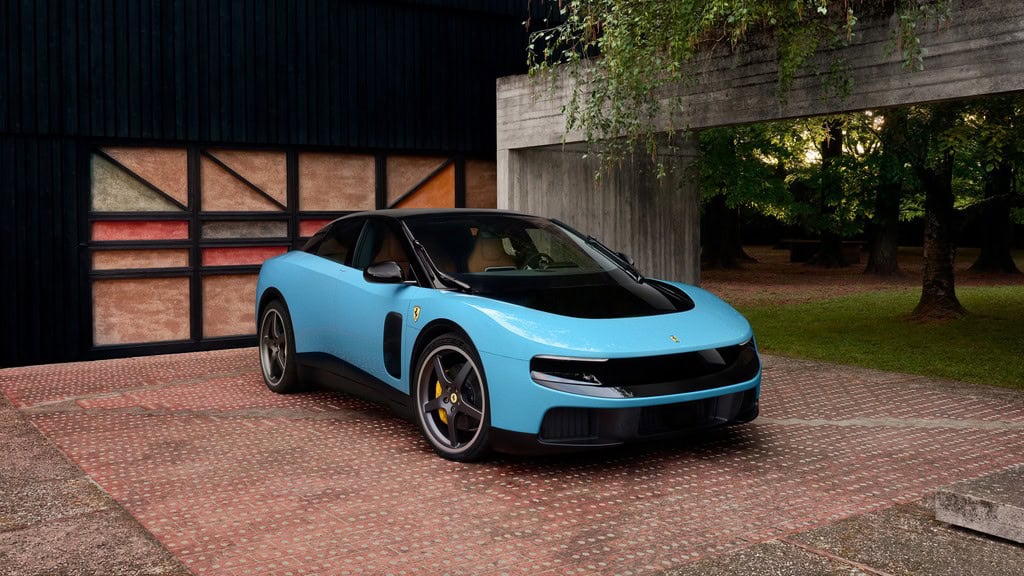
Ferrari has revealed the Luce, its first-ever electric vehicle and arguably the most significant model in the Italian brand’s modern history. Unveiled in Rome ahead of an expected Australian arrival next year, the Luce is a five-seat, four-door EV that is expected to cost more than $1 million locally.
And with it, Ferrari says, comes an organic soundtrack to rival that of its petrol-powered supercars, but more on that in a moment.
READ MORE:
Ferrari CEO: “It’s our job to push forward EV innovation, but autonomous cars? No, never”
BYD wants to race in F1!
Light speed: Ferrari Luce named
The firsts keep coming for the Luce: It is Ferrari’s debut EV, its first five-seat production car, and the first model since 2010 to have had its design entirely outsourced.
The Luce was styled inside and out by LoveFrom, the US-based design collective founded by former Apple design chief Jony Ive and Australian designer Marc Newson, rather than Ferrari’s in-house design studio.
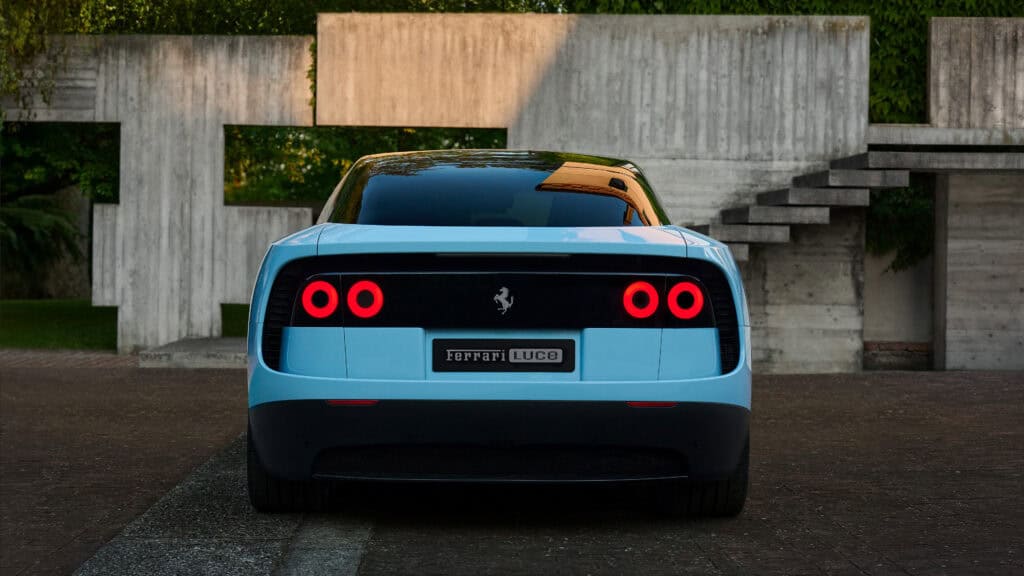
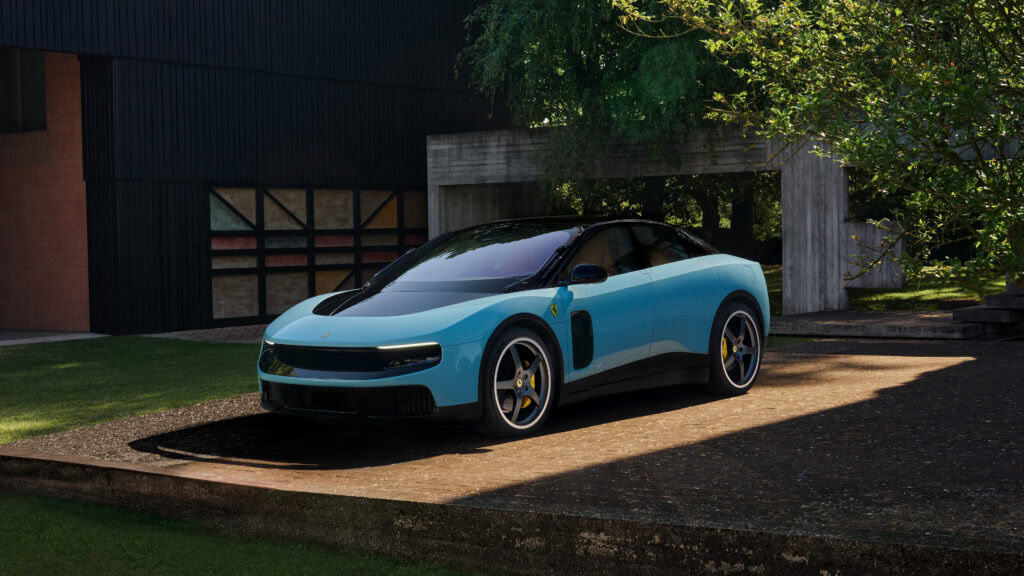
The result is a huge departure from Ferrari’s usual supercar look, with the Luce adopting a smoother and more subtle four-door EV profile, a large glasshouse and a body designed heavily around aerodynamics.
“The concept that we came up with very, very early on — which became kind of the overarching philosophy of part of the exterior design — was this idea that you had an interior glasshouse, which is basically this large, black glasshouse area,” Newson says.
“That’s essentially surrounded by the body of the car, which at the end of the day is probably doing most of the aero work.
“The reason we identified that as a really interesting direction, or an interesting sort of philosophy to pursue, was that it gave us the opportunity to create some very clean and very unique forms.”
Newson says the intention was not to create a conventional Ferrari shape with an electric powertrain, nor even to immediately appeal to the petrol-loving Ferrari faithful. This, it seems, is a new vehicle for a new era, and likely a new customer.
“This is a different kind of Ferrari. And that was the point. That was the entire purpose of the exercise,” he says.
The Luce uses four electric motors, one at each wheel, producing a combined 772kW and 990Nm. Ferrari says that is enough for a 0-100km/h time of 2.5 seconds and a 0-200km/h time of 6.8 seconds.
Each wheel can deliver power, harvest energy, provide steering inputs or control vertical movement to help improve grip, with Ferrari claiming the system gives the large EV surprising agility befitting the brand.
“The car has an agility that you don’t expect, that you cannot link with your perception of the dimensions of the car,” says Raffaele de Simone, Ferrari’s head of test development and test driving.
“The feeling of the Luce is based on the fact that at these four corners, the four motors are managed by a control unit that decides how to satisfy [the driver] in a very harmonic way.
“You don’t perceive which system is working on the four corners, you just have to turn the wheel, to place the car where you want on the road, and the car goes there.”
The Luce’s gearshift-style paddles control torque delivery and regenerative braking, rather than mimicking traditional gear changes. They can increase braking or dial up the torque flow, with the system designed to make the drive more engaging, rather than being “driven by a computer”.
“On the left side, you increase the engine braking, exactly like a combustion-engine car. On the other side, you unleash power,” de Simone says.
“The more you go on the left, the more you have engine braking. The more you go upshift, the more you release power. These power stages are called Torque Index.
“It’s something that, with electric powertrains, was not possible. You were driven by computers, managing in your place the stability of the vehicle. Now you are back to driving, you are back to control, and this is a tool to control it.”
Power comes from a 122kWh NCM battery, with Ferrari claiming a driving range of more than 500km. The battery has also been designed to be repaired or replaced, allowing for the possibility of future battery upgrades.
Drive modes do limit output to prevent drivers burning through juice, with Range mode capped at 320kW through the rear motors, Tour mode using all four motors for 460kW, and Performance mode unlocking 725kW.
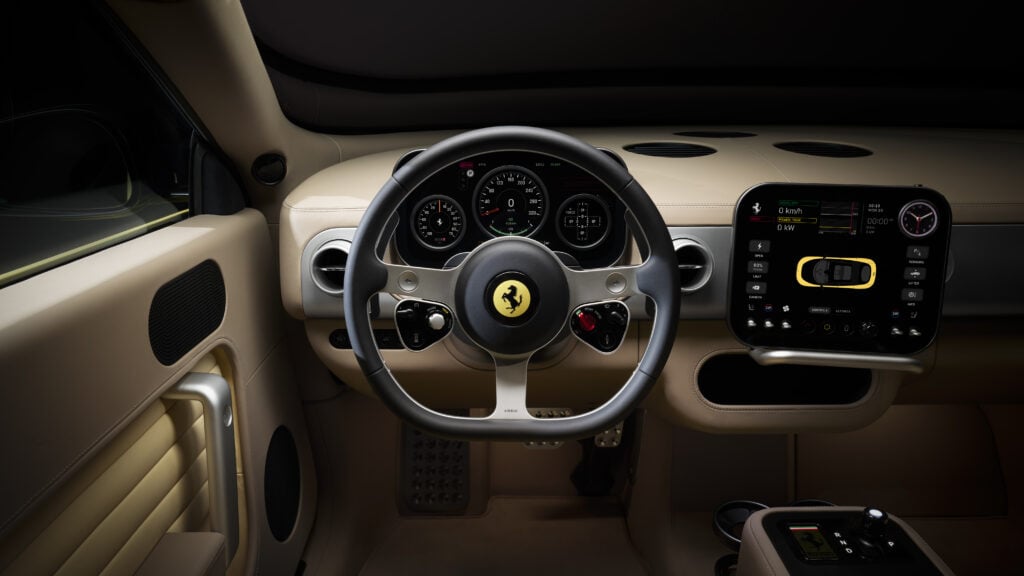
Inside, the Luce moves further from traditional Ferrari cabins and into a tech-focussed future, with a hugely complex layered driver display, physical needles, a hinged central screen that can be angled towards the passenger, and aluminium and glass switchgear.
A thin, elegant steering wheel frames the new driver display, in which the top screen has circular cut-outs, creating a gauge-like impression for the screen behind. Physical needles are then attached, rising and falling with your inputs.
The central screen is a thing of beauty, too. It is hinged so it can be angled towards the passenger if required, while the switches and toggles beneath are exclusively aluminium or glass. In the top right corner, another needle-adorned digital gauge can cycle through a clock, stopwatch or compass.
Another fun first is the launch-control function, accessed via a fighter-pilot ejector-seat-style handle mounted next to the driver’s head.
“It’s a fusion between digital and analogue, and the physical world,” Ferrari says.
So, the sound. Ferrari has also developed an electric sound system that captures real sounds and vibrations from the electric motor, then amplifies them inside and outside the cabin.
The brand says the system was developed over five years and 40,000km of dedicated track testing, and likens the solution to an electric guitar.
“Now one might wonder, ‘Okay, but you are amplifying, so it’s fake, right? It’s fake, you’re amplifying,’” says Antonino Palermo, vehicle NVH and sound engineer at Ferrari.
“If we think of the musical parallel, an electric guitar musician — Jimi Hendrix, Jimmy Page, David Gilmour — when they are playing, they have expressivity. When they play the guitar you can feel the human aspect, the intention.
“Here the musician is you. It’s your driving.”
The Luce weighs 2260kg, but Ferrari says its low battery position helps lower the centre of gravity by 95mm compared with the Purosangue.
Ferrari claims the result is an EV that feels at least 400kg lighter when cornering than its actual kerb weight.
“You look at the car on the outside, you go into it with a forecast of what a big car could be like to drive,” de Simone says.
“Where to place in this scenario the experience of the Luce? The car has an agility that you don’t expect, that you cannot link with your view of the dimensions of the car.
“For this type of car, in terms of size, roominess and versatility, there is no connection with the handling of the car. This ratio has been completely rewritten.”
The Luce marks Ferrari’s big, bold step into the electric era, and arrives as several other supercar brands reassess the timing and demand for high-performance EVs.
Is the Ferrari world ready? We’re about to find out.