Van driving scarred me, but Ford’s E-Transit is my over-priced salvation | Opinion
I have many miserable memories of vans.
Growing up in 1980s England, vans then were (and remain) the tradie transport of choice. While Aussies buy roughly ten times more utes than vans, it’s vice-versa in the UK.
Walking to school, diesel fumes from crappily maintained vans would sit in the cold, still air. Our youthful lungs were coated by a blackened film of diesel particulates, likely doing more damage than the Marlboro Reds we’d puff on at break time.
And that awful diesel chatter. The French vans were the worst. Peugeot J5s and Renault Trafic shitters: They’d sound like a cross between farm tractors and broken sewing machines, and would vomit out a dense cloud of black smoke at every pull-away.
READ MORE: Ford E-Transit Custom Trend Review: Why don’t we rate it higher?
READ MORE: Legacy car brands must embrace their heritage or die. So where’s our damn Renault 5?
READ MORE: 2026 Kia PV5 Cargo Review: Funky van with compelling EV drivetrain.
In the late 1990s, I worked delivering vans for a vehicle wholesaler. I came to appreciate their awful unladen ride quality, frightening handling with obese body roll, woeful performance and engine noise that brought on piercing headaches. Or maybe that was the diesel fumes. Or both.
Worst was rowing through the gearbox, enduring a ridiculously long manual shift throw, trying to find a gear low enough to make it up a steep hill. The low-revving angry diesel at noisy bursting point, it’d barely get up any gradient. God knows how they did with a tonne in the back.
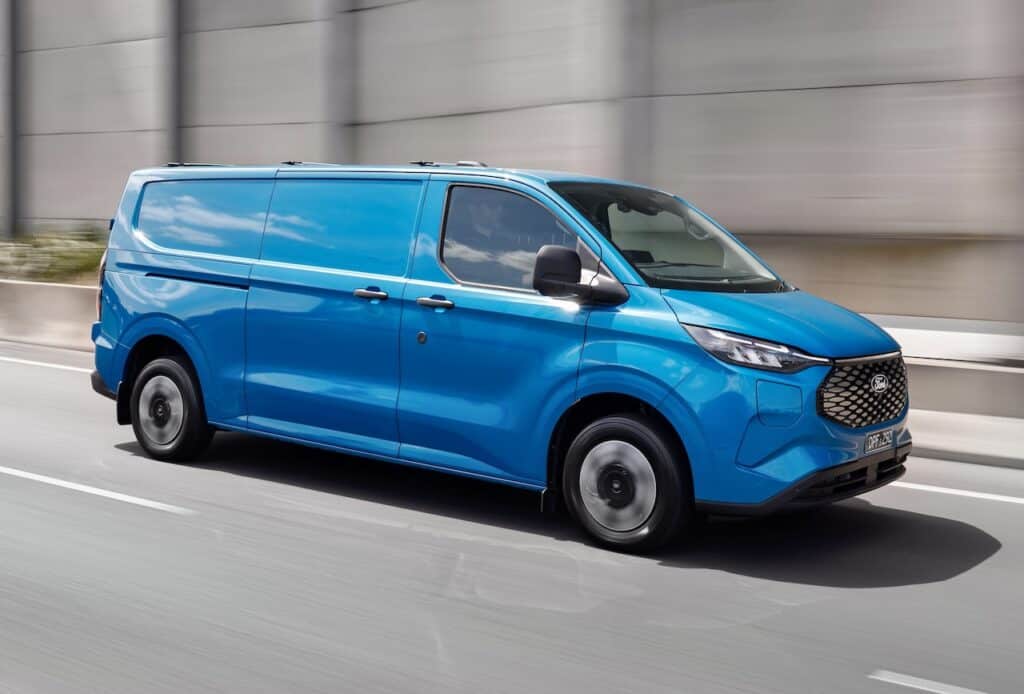
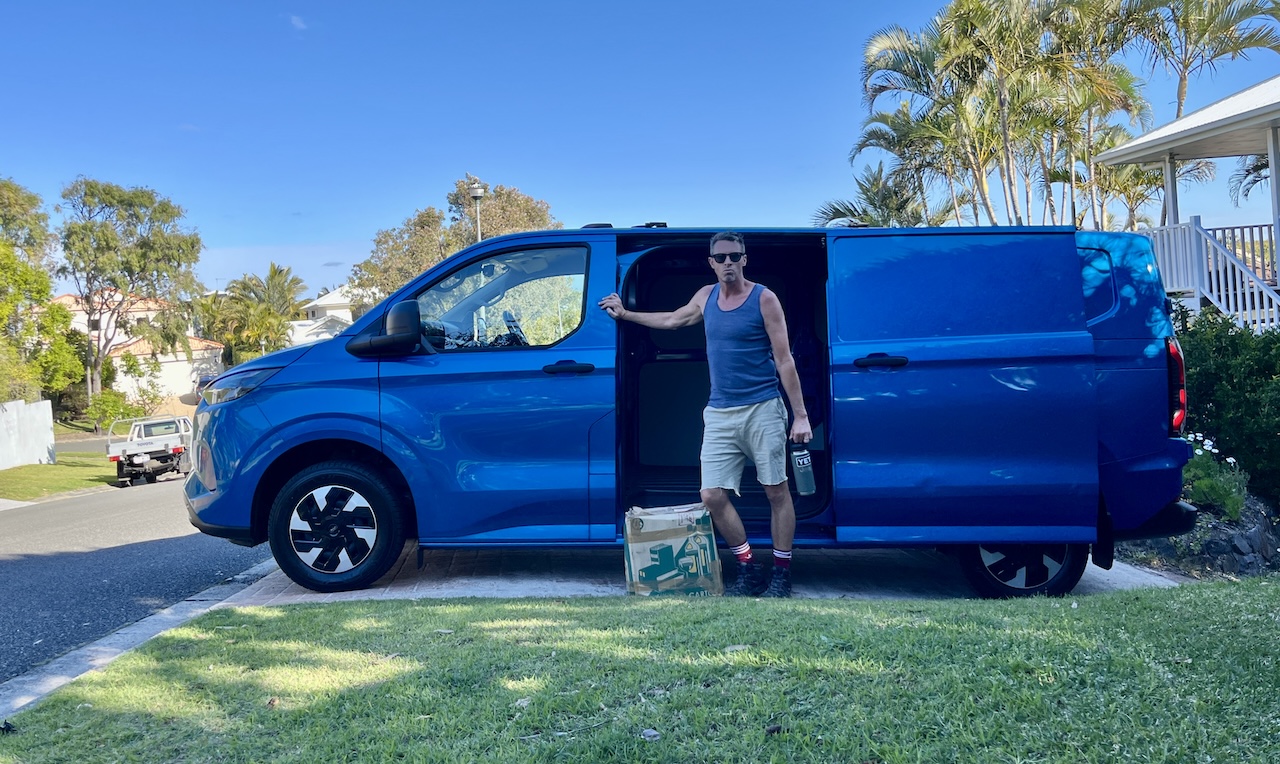
Today, driving a Ford E-Transit, it’s a different universe.
Electric vans get a right kicking these days, and it’s obvious why. Next to diesel variants they’re dramatically more expensive, have less payload, lower towing capacity, and worst of all, not even half as much range between fill-ups.
Refuelling quickly is imperative for working vanners, so a one-hour EV charge next to a three-minute diesel fill costs time and money.
But hang on. Case for the EV van defence here.
Having been life-scarred by diesel van driving in my early 20s, living with Ford’s E-Transit Custom is like salve for the soul.
No noise. Wads of torque on tap with each throttle squeeze. No spewing exhaust pipe. And hills present no dramas; the electric Trannie hauling up inclines with no nasty down shifts nor flaring engine required.

One-pedal driving means a level of relaxed vanning simply impossible in combustion versions. It’s all rather serene in traffic, timing one’s stops to perfection with a lift off the throttle.
It also helps that Ford’s created arguably the world’s finest ever van to drive, and that applies to the diesel, plug-in petrol or this electric variant.
There’s fancy independent rear suspension helping ride quality and handling, and unladen or with almost a tonne in the back, the Transit absorbs bumps well and corners safely.
I’m not blind though; van traits remain. You sit very high almost over the front wheels; scratchy cabin plastics do not compute with the price tag, and cloth seats with manual adjust are highly workmanlike. At least they’re heated.
Ah, the price. Well, this is awkward.
Over $83,000 to drive-away a long wheelbase E-Transit Trend. Or, if preferred, a short wheelbase Sport edition is around $86,000 in the traffic.

Our BEV Transit is therefore $10k more than a plug-in variant (with 53km pure electric driving range); or $20,000 more than a purely diesel one.
Rivals also make the Ford look daftly pricey. A VW ID.Buzz Cargo starts from $69,990; Peugeot e-Partner $59,990, Kia PV5 $55,990, Farizon V7E $49,990 drive-away and LDV eDeliver 5 $47,990 drive-away. Although the Transit beats them all for size.
Anyway, let’s say ‘stuff it’ for a minute. There’s more to life than money. And just think of the optics. If you’re a small business doing local delivery jobs with zero emissions, your customers will get the warm and fuzzies about you and your electric van’s virtue signalling.
Plus, and here’s a bit of fun, the E-Transit is the only variant with rear-wheel-drive: the others are all-paw or front-drive vans. And we all know proper drivers prefer power through the rear.
Our EV pumps more torque through its back wheels than you’ll find on other Transits: a mighty 415Nm from zero revs, while the diesel’s best effort is 390Nm from 1750rpm. It’s also 160kW versus 125kW in favour of the electric.
Just for giggles, can you think of another vehicle costing north of $80k that runs 16-inch steelies and 215/65 rubber? Blue collar spec, white collar price.
Back now grounded in reality, by most other measurables the E-Transit’s a terrible choice.

Let me compare it to the diesel Transit Custom LWB.
With a 71.45kWh usable battery, our electric Transit has range of 340km: The $20k-cheaper oil burner will do 875km from its 70L diesel tank.
Payload is 1199kg versus 1113kg, and towing 2800kg versus 2300kg, both in favour of the diesel. The combustion one has a full-size spare wheel, the EV a pesky repair kit.
Positively, they share the same 5.45m overall length, 6.8m3 load volume, and ability to take four Euro-size pallets. It also swallowed our two kayaks (see below) to show its lifestyle usability too.
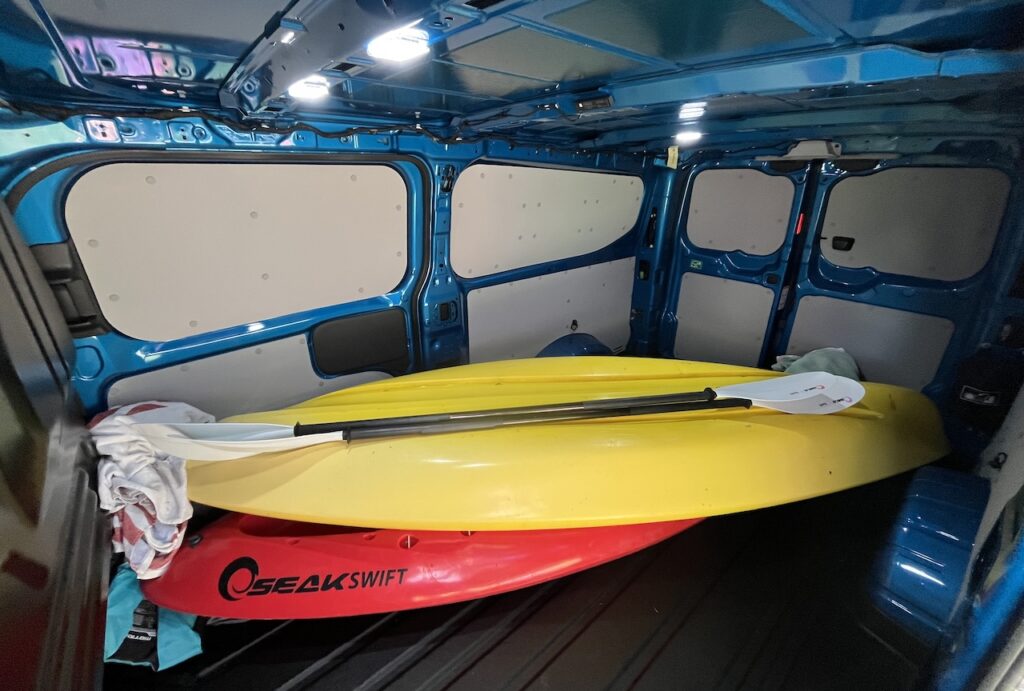
After a week of playing at van life, the E-Transit has convinced me it has a very specific, niche use case.
Businesses doing regular short journeys from the same base (where you’ll have a charge point), and to customers that will appreciate your zero emissions ethos. Think your local high-end furniture store, florist, holistic/wellness shop or organic grocer. Your clientele will pay more, surely, knowing their retailer is Doing the Right Thing.
The E-Transit will AC charge at 11kW when it’s grounded, and that happily keeps the battery topped up between jobs, and manages a full charge overnight.
I used it in this manner, recharging little and often and I never had range anxiety while keeping drives local.
For the vast majority, however, the business case for this E-Transit is impossible to make. It’s too dear, and doesn’t “van” as well as the diesel version.
But I’ve stopped caring. I’m not about to revisit dirty diesel van life. If your business can swallow the purchase price, electric vanning is the life for me, and should be for you too.