Forget the knockers! Why the experts reckon EVs are critical to the future health of the Australian electricity grid
While critics argue electric vehicles will be a drain on Australia’s electricity grid, the nation’s energy market operator is now forecasting they will become a critical part of its future health.
In a fundamental shift in thinking, the Australian Energy Market Operator’s (AEMO) 2026 Integrated System Plan (ISP) formally recognises EVs and EV charging as Consumer Energy Resources (CER) alongside rooftop solar and home batteries, reflecting their future role as part of Australia’s electricity system rather than simply power consumers.
The ISP, which maps out the least-cost pathway for developing Australia’s National Electricity Market over the next two decades, assumes around 80 per cent of vehicles on Australian roads will be electric by 2050, driving road transport electricity demand from about 1 terawatt-hour (TWh) today to 61TWh by mid-century.
READ MORE: V2G is go for Hyundai and Kia in Australia! Vehicle to grid fitted to Korean EVs this year. It’s a big deal, but there are limitations
READ MORE: Grid up! Regulation rewrite boosts bi-directional charging in Australia to enable V2G, V2H
READ MORE: Big step forward for V2G in Australia: Federal government’s huge investment expansion
While that represents a dramatic increase in electricity consumption, AEMO’s modelling also sees electric vehicles becoming an important source of energy storage and grid flexibility rather than simply additional demand.
Under the ISP, more than 10 per cent of household EVs are expected to participate in vehicle-to-grid (V2G) programs by 2050, providing approximately 4.3GW of flexible capacity and almost 49GWh of distributed storage to help support the electricity network.
The report also highlights the growing importance of charging infrastructure beyond the home, identifying workplace, kerbside, commuter car parks and on-road charging as critical elements of Australia’s future charging network.
One of the more significant findings is the role of commercial vehicles, with AEMO forecasting around half of future road transport electricity demand will come from freight and commercial fleets, underlining the need for large-scale depot charging and dedicated heavy vehicle charging corridors.
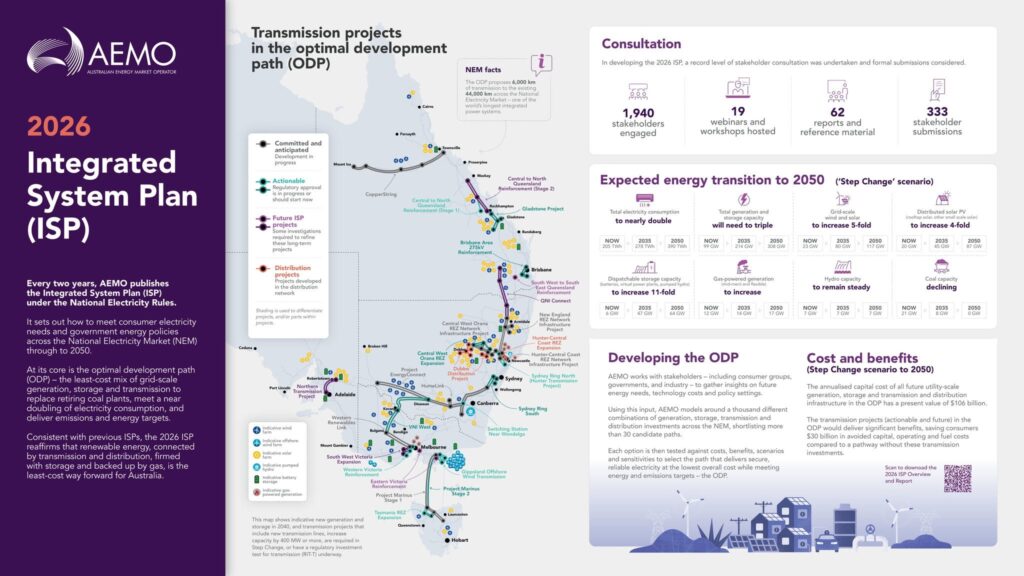
The ISP does not attempt to forecast EV sales. Instead, it uses long-term transport electrification assumptions to determine the generation, transmission and storage infrastructure required to deliver electricity reliably and at the lowest practical cost over the coming decades.
By explicitly classifying EVs and charging infrastructure as Consumer Energy Resources, AEMO places transport electrification alongside rooftop solar, household batteries and other distributed technologies that can both consume and supply electricity, recognising the increasingly important role bidirectional charging is expected to play as Australia’s vehicle fleet electrifies.
The Electric Vehicle Council welcomed the findings, saying they reflected the increasingly important role transport electrification will play in Australia’s energy future.
“Electric vehicles are no longer just cars that get you from A to B. AEMO is telling us that EVs are becoming part of Australia’s energy system and playing an increasingly important role in supporting the grid,” Electric Vehicle Council chief executive Julie Delvecchio said.
The council also said the ISP highlighted the need for a coordinated national charging strategy, particularly for commercial vehicles, arguing the next challenge will be determining how much charging infrastructure Australia needs, where it should be built and how freight charging corridors should develop as transport electrification accelerates.