Ford reinvents its global EV future: Eight affordable new models led by dual cab ute coming to tackle the Chinese head-on
Ford has responded to the existential threat Chinese manufacturers pose by announcing a new wave of cheaper EVs underpinned by a new platform and manufacturing concept.
As reported yesterday, the first model will be a “mid-size” dual cab ute likely named Ranchero that will be on-sale in the USA in 2027 priced from $US30,000 ($46,000).
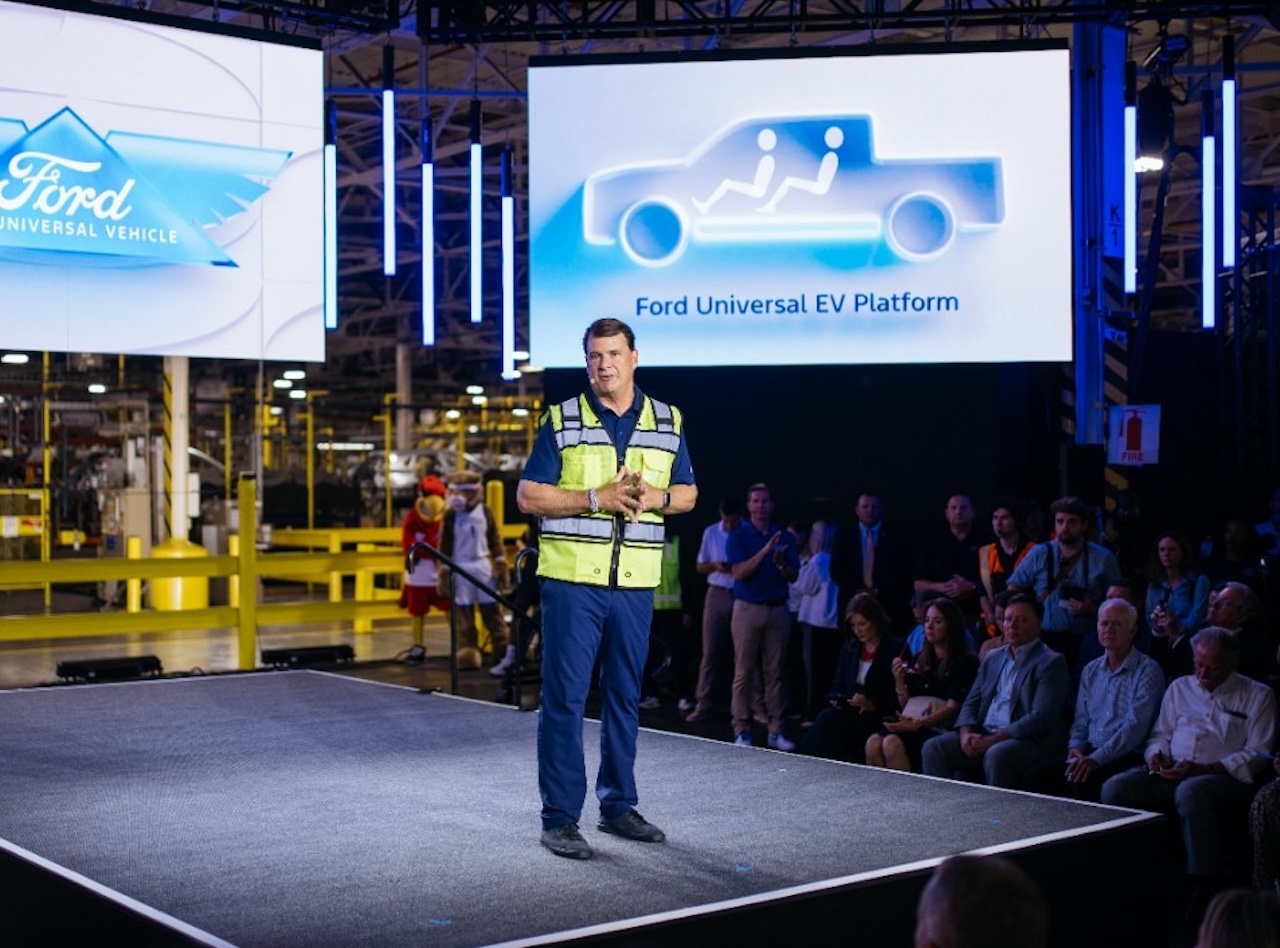
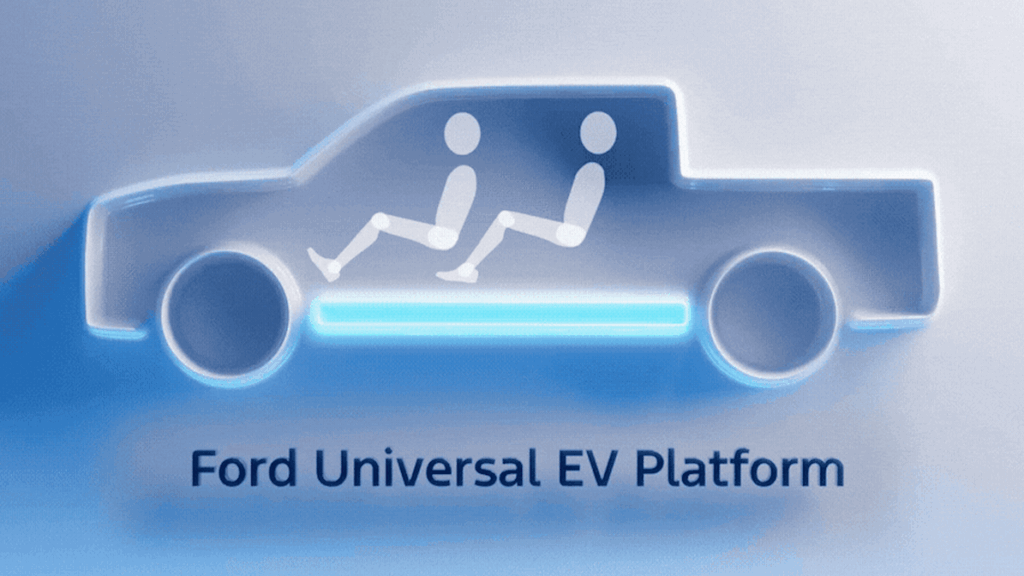
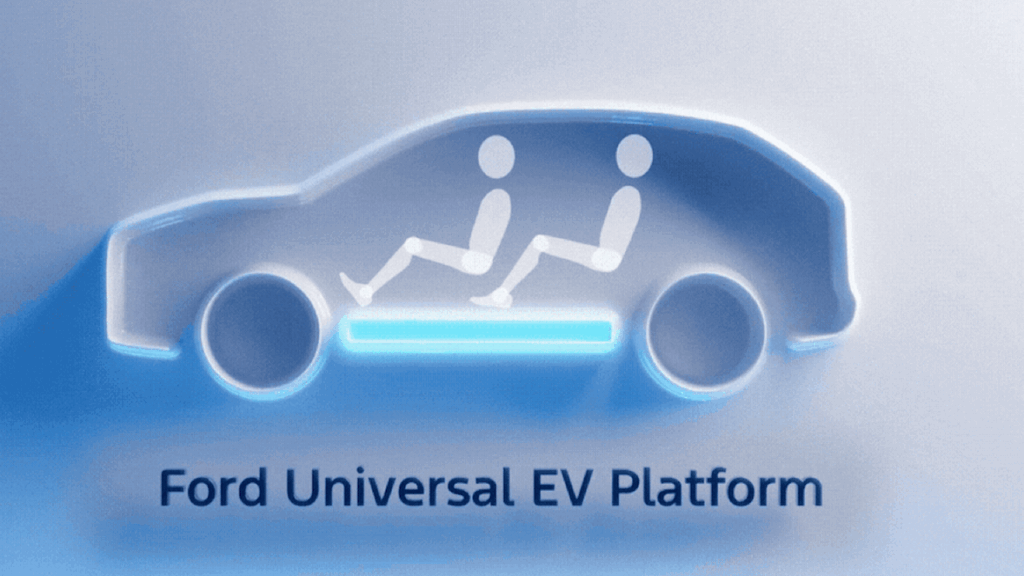
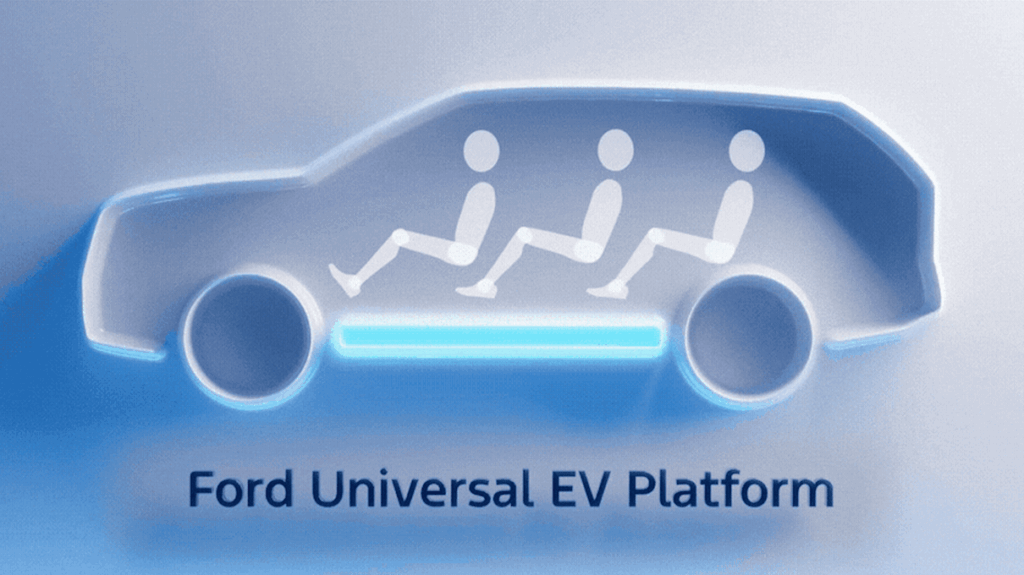
It will be the first of as many as eight EVs that will be built on what’s called the Ford Universal EV Platform using the Ford Universal Production System.
READ MORE: Ford Ranchero EV is go! Ford F-150 Lightning delayed until 2028 but Blue Oval is working on much smaller more affordable car-based ute
READ MORE: V8 burn-out? Australia’s new NVES CO2 reduction scheme drives huge price rises for iconic Ford Mustang muscle car
READ MORE: More competition for LDV, Benz and VW in mid-size vans: Ford confirms pricing for Transit Custom EV and PHEV
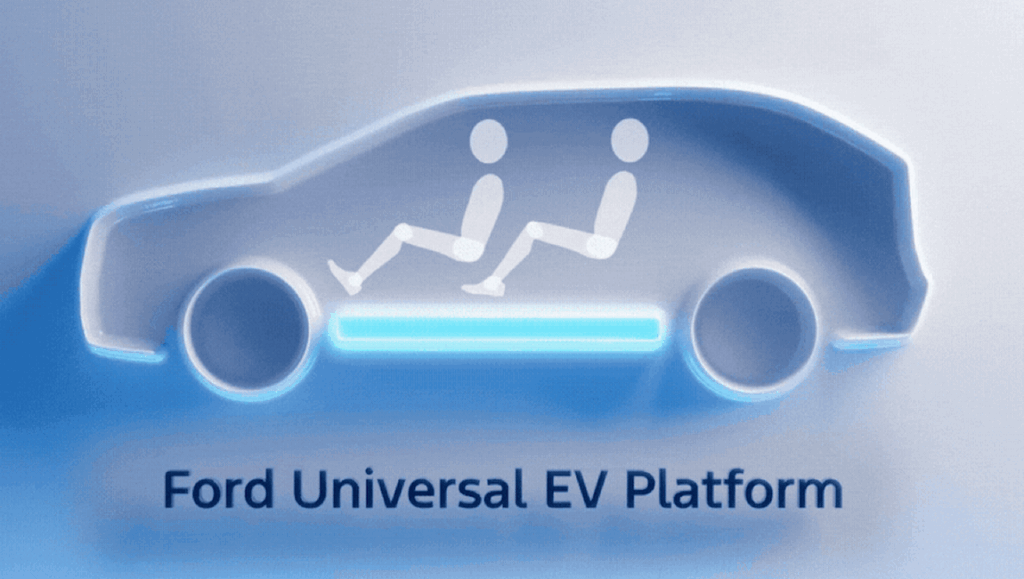
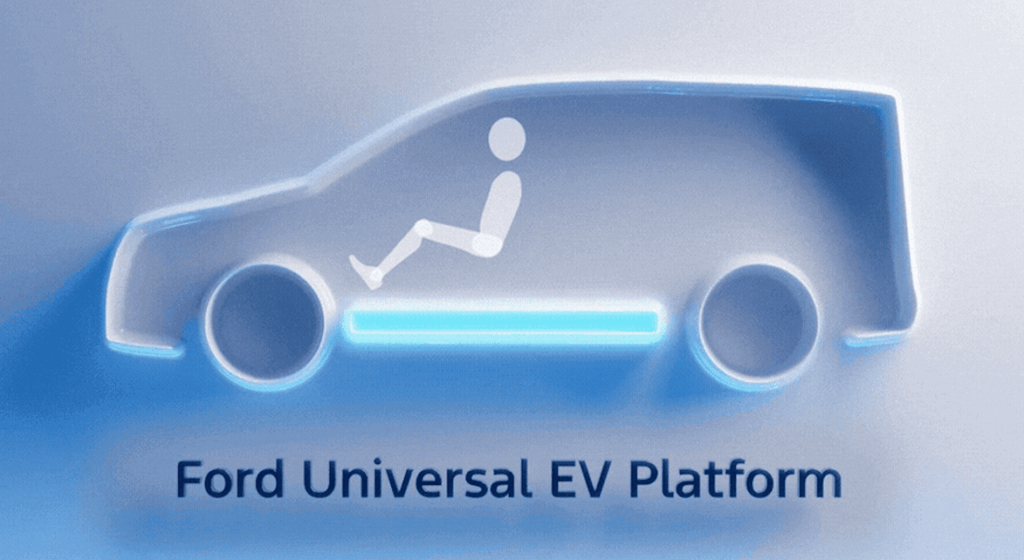
Other models hinted at in graphics accompanying the announcement include two- and three-row SUVs, passengers cars, a people mover and a commercial van.
At least some of these new EVs seem certain to come to Australia. In its official statement Ford said its aim was “to bring a new family of affordable, high-quality electric vehicles within reach for millions around the world.”
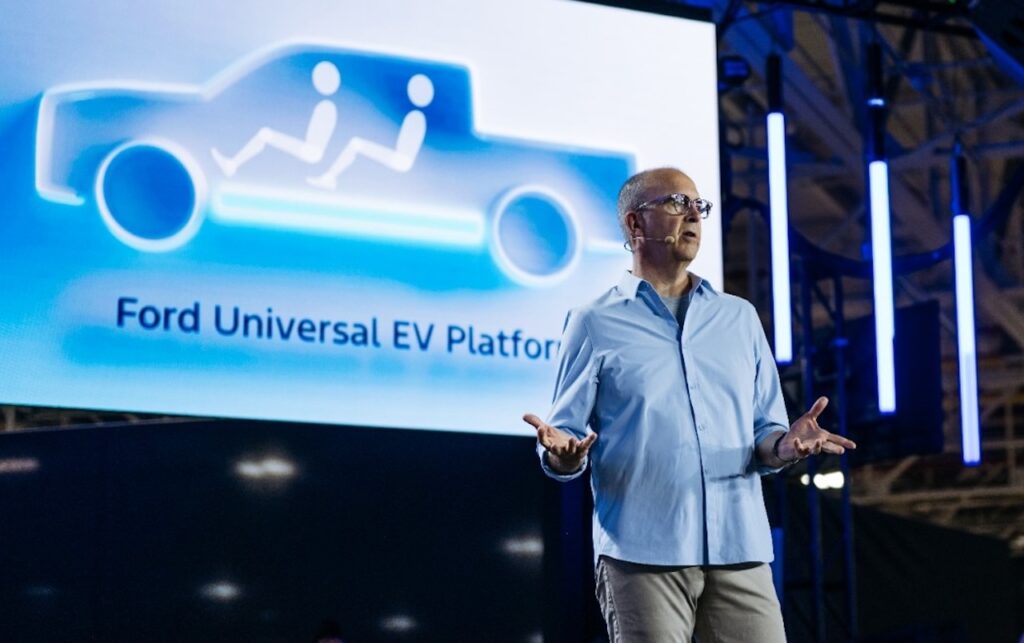
The dramatic EV overhaul was announced overnight by Ford president and CEO Jim Farley (pictured top) at the company’s Louisville, Kentucky, assembly plant, which will be the subject of a $US2 billion refurbishment and the home of the ‘Ranchero’ and other as yet unspecified ‘Universal’ models.
Ford will invest a further $US3 billion in a battery plant in Michigan, which will become the first in America to manufacture prismatic LFP battery cells (cheaper-to-manufacture LFP tech is used extensively by Chinese car makers).
It says all this investment will create or secure 4000 jobs across the two locations.
No doubt all this will delight US President Donald Trump, who has waged a relentless campaign to bring manufacturing back to the USA since his re-election.
The new strategy is the result of a three-year program that began with the creation of a small skunkworks team in California to chart a new course for Ford’s EV future.
“The automotive industry in America is at a crossroads. We’re at a crossroads about new technology and new competition coming from everywhere,” said Farley.
“We saw this coming for years, we knew the Chinese would be the major player for us globally. Companies like BYD, new start-ups from around the world, big technology has their ambition in the auto space.
“They are all coming for us legacy auto makers.”
Ford says its 2027 electric pick-up will accelerate faster than a Ford Mustang Ecoboost (that’s the twin-turbo four-cylinder, not the V8), have more interior space than a Toyota RAV4 SUV, include a frunk (under bonnet storage) and lockable truck bed.
It will also have V2L capability, over the air updates, Ford’s BlueCruise hands-free automated cruise control and new technology features that have yet to be revealed.
The Ford Universal EV Platform is designed to dramatically reduce the cost of electric vehicle engineering.
Ford says the body reduces parts and welds by two-third versus a typical pick-up, with 50 per cent fewer fasteners.
The wiring harness in the new mid-size truck will be more than 1.3km shorter and 10kg lighter than the one used in first-generation Ford EVs.
Ford also says the lithium iron phosphate (LFP) prismatic batteries will enable space and weight savings and cost reduction.
“Compared to a typical generation one electric vehicle we can get the same range with a third less battery,” explained Doug Field, Ford’s chief EV, digital and design officer. “That’s the kind of ingenuity we need to compete with the Chinese.
“Are we going to compete on labour to make batteries? No. But if we use our brains … we can compete.”
Field, who was formerly one of Elon Musk’s key executives at Tesla and worked on Apple’s auto project, promised the ongoing costs of ownership of the new Ford EV would be cheaper than “a three-year-old Tesla Model Y”.
“And they’re pretty cheap,” Field said.
The platform’s cobalt-free and nickel-free LFP battery pack is a structural sub-assembly that also serves as the vehicle’s floor and is assembled with seats, consoles and carpeting.
The new production system abandons the traditional assembly line and instead is an ‘assembly tree’.
Large single-piece Tesla-like aluminium uni-castings replace dozens of smaller parts, enabling the front and rear of the vehicle to be assembled separately.
They are then combined with the structural battery to form the vehicle.
The new system results in 40 per cent fewer workstations dock-to-dock in the plant and 15 per cent faster assembly time.
Ford also says the new system dramatically improves ergonomics for assembly line workers.
Farley, who invoked the spirt of company founder Henry Ford and his introduction of the Model T on a moving assembly line more than 100 years ago, made it clear what was at stake for Ford with this new EV direction.
“Our competitors build their affordable vehicles in South Korea and Japan and import them, but not us at Ford.
“There are no guarantees with this project, we are doing so many new things I can’t tell you with 100 per cent certainty that this will all go just right.
“This is a bet, there is risk. The automotive industry has a graveyard littered with affordable vehicles that were launched in our country with all good intentions.
“And they fizzled out with idle plants, laid off workers and red ink.
“At Ford we set out three years ago to break that cycle. No more compliance cars, no more loss leaders that require a big cheque from the company to make.
“We’re talking about a vehicle that can sustain itself and have strong profits.”