Sound systems are the new horsepower: Why car makers are building studios on wheels
Forget kilowatts.
As part of the tech push infiltrating cabins the new bragging rights in cars are speaker counts, amplifier channels and studio credentials – as well as a brand name you could easily find in a high-end house.
As cars get quieter – and that lovely thing called traffic means owners spend more time stuck in them – the cabin has become prime listening real estate.
Car makers have noticed. The result is an arms race that has turned the humble car stereo into one of the most complex and consumer-friendly features in a modern vehicle.
The latest salvo comes from Cadillac, which has teamed lesser known studio brand AKG with Dolby Atmos in its Optiq and Vistiq electric SUVs; up to 23 speakers aimed at recreating a recording studio while on the road.
“Music’s becoming more important and people are connecting more,” says Spencer Scott, Acoustic Systems Engineering Manager for Harman International, which is owned by Samsung and in charge of many audio brands, including Harman Kardon, JBL, Marantz, Denon, Lexicon, Mark Levinson, Bowers & Wilkins and Becker.
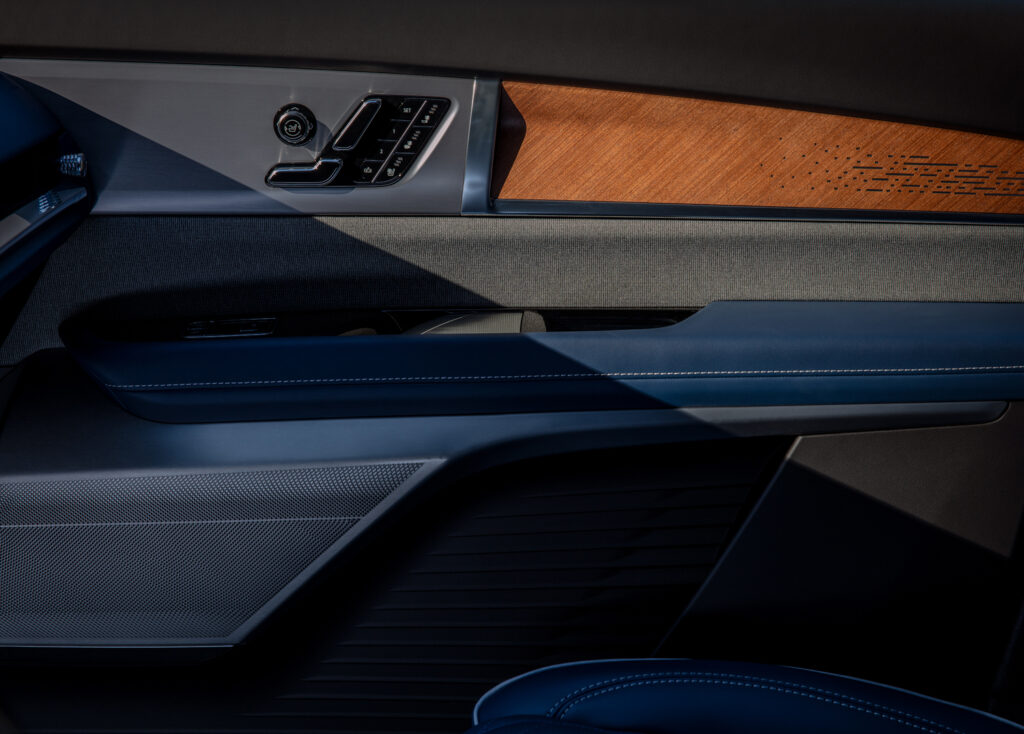
Based in Detroit, Scott oversaw the engineering and development of the AKG sound systems in the latest electric Cadillacs, including the recently-arrived Optiq and Vistiq.
Why cars now have studio-quality sound systems
It’s a long way from the days when an FM radio and a pair of speakers counted as high-tech.
Fittingly, it was Cadillac that kickstarted the branded car audio revolution.
In 1983 Bose – one of the few independently owned audio brands used in cars – fitted a modest four-speaker amplified system to the Cadillac Seville.
It was the first time a respected home audio company had put its name inside a car.
It was a hit, and it spawned a proliferation of speakers, amplifiers and subwoofers that turned cars into boomboxes on wheels.
Four decades on, branded audio has spread from Bentleys to Toyotas, and the market is dominated by two players: Bose and Harman.
Harman – owned by Korean electronics giant Samsung – controls a stable of audio brands including JBL, Harman Kardon, Infinity, Mark Levinson and AKG, allowing it to offer price step-ups within a single car brand as well as bespoke systems to competing manufacturers.
What’s changed is when the audio people get involved.
Once an afterthought fitted to tick a brochure box, sound systems are now baked in from the first sketches.
“We’re involved from the very beginning,” says Scott.
“We’re involved with speaker placement, speaker integration in the car. We do multiple rounds of tuning to make sure that we’re getting the best experience for the end user.”
And there appears to be almost no end to the audio largesse.
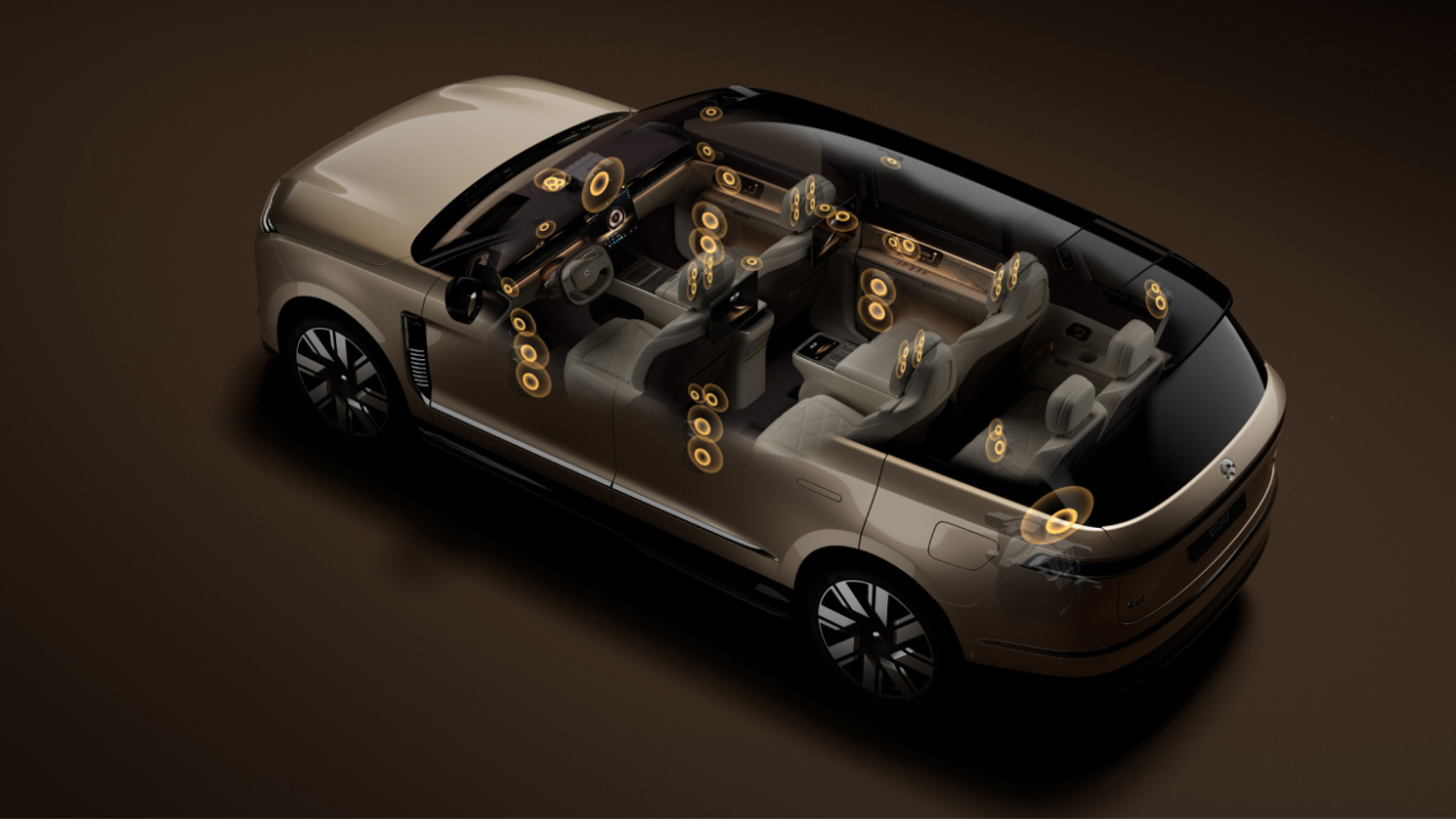
Chinese car maker Nio recently unveiled a large luxury SUV with a 47-speaker sound system.
Why a car is one of the best places to listen to music
For all its compromises, a car cabin is one of the best listening room most people will ever own.
“In a reference studio room you’re sitting in the centre, your speakers are perfectly placed all around you, you have perfect full-range speakers,” says Scott.
“In the car environment that’s just not possible.”
Instead, AKG builds each channel from a collection of speakers carefully positioned around the cabin, each covering different frequencies, digitally stitched into a sound stage.
And, of course, the car has one big advantage over your lounge room: every cabin of a particular model is identical.
Your home hi-fi fights different room layouts, variable materials and speakers that can’t always be optimally positioned.
Engineers tuning a car know exactly what they’re dealing with – down to the millimetre – and every example that rolls off the line sounds the same.
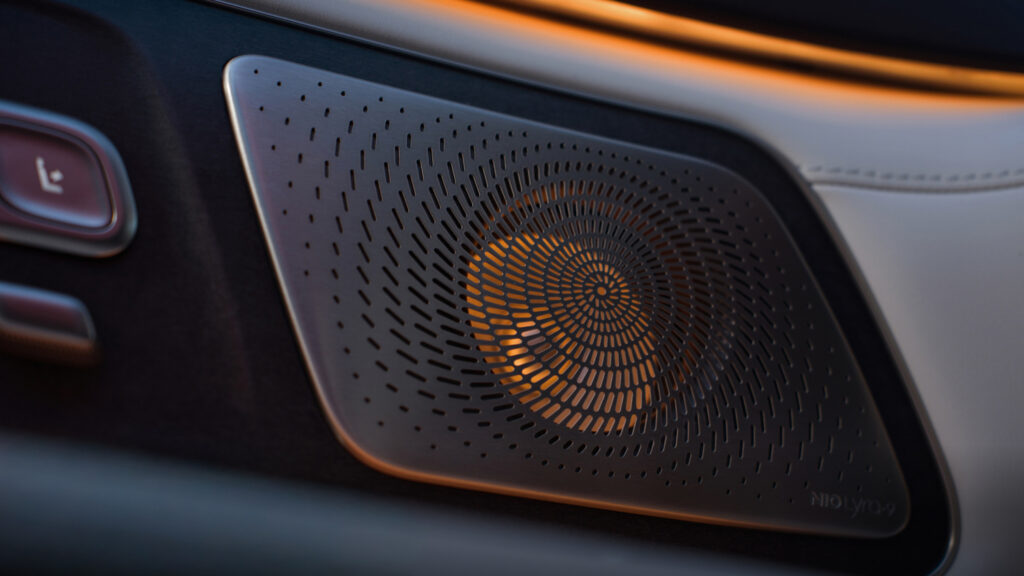
“Almost always we’re listening in compromised situations,” says Dr Mike Mason – Director of Entertainment Technology, Music Ecosystem Dolby.
“Of all those situations, this is one of the least compromised … it’s probably one of the best consumer systems you’re going to get your hands on.”
Why AKG is exclusive to Cadillac
Harman spreads its audio brands liberally across the industry – Ferrari and Toyota both use JBL, for example.
But AKG is different. Like Mark Levinson with Lexus, the brand is locked exclusively to Cadillac.
It’s a deliberate move for a badge with serious studio heritage.
“It was born in the studio, it’s a studio brand,” says Scott.
“The C414 microphone is a trademark in all studios. A lot of artists have the K240s or the K702s as their reference headphones.”
Exclusivity, he says, lets Harman uphold the brand more strongly – and get in deeper.
AKG first appeared in the 2021 Cadillac Escalade in the United States.
It’s a different philosophy to Bose, which sets a minimum standard and then lets manufacturers tick boxes on how much better they want to go – the reason a Bose system in a Mazda and a Bose system in a Porsche are very different beasts.
The hidden war inside cars with top-shelf sound
Every big sound system is the product of a low-level turf war between audio engineers, vehicle designers and engineers and accountants.
Speakers sometimes need prime positions. Amplifiers and speakers add weight the engineers are desperately trying to shave elsewhere. And beancounters are ever-eager to keep costs down.
“There is definitely some requirements we have, and it can be a bit of a contentious issue,” admits Scott, who sits in on every packaging meeting and pores over CAD data to defend speaker real estate.

“But we try and start from a place of data. We’ll take measurements, we’ll try different positions.”
Then comes the tuning. Microphones are placed in the seats for objective measurement before trained listeners take over – AKG puts its acoustics engineers through a formal training program so they can hear flaws “that maybe others might not pick up on”.
Early prototypes are also hunted for what the industry calls BSR – buzz, squeak and rattle – the parts of a car that vibrate when the bass kicks in.
But more powerful speakers can sometimes win that argument.
“At some point there’s only so much you can do with physics,” says Scott.
There’s a separate battle against the road itself.
Many sound systems constantly adjust their tuning to compensate for road and engine/motor noise as speed rises – though don’t expect it to mute a passing siren; active cancellation of outside one-off noises isn’t on the menu yet.
The next frontier: Dolby Atmos
One of the biggest shifts in car audio isn’t more speakers. It’s what’s coming down the wire.
Dolby Atmos – the object-based surround format born in cinemas – is spreading rapidly into cars.
Rather than mixing a song into two stereo channels, artists working in Atmos use overhead and surround speakers to place up to 128 individual “objects” – a vocal, a snare, a keyboard stroke – anywhere in three-dimensional space, including above the listener.
In the Cadillacs, that mix is rendered down to a 7.1.4 configuration: seven surround sound speakers around you, four overhead and a subwoofer.
Dolby says that’s the top of the resolution scale for automotive Atmos. Mercedes-Benz, first to put Atmos in a car, runs a 5.1.4 setup.
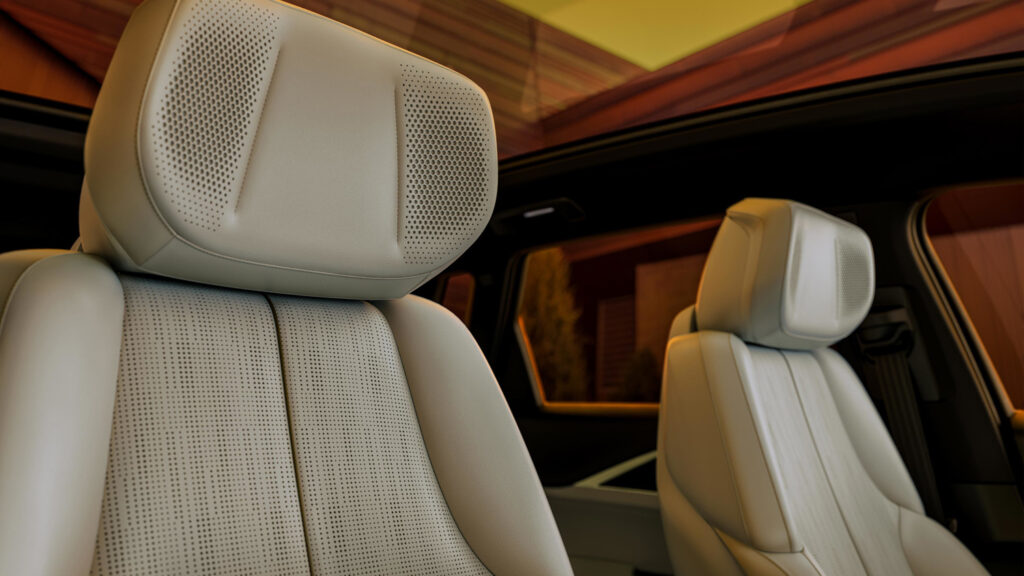
By the way, that 47-speaker system mentioned earlier in the Nio is claimed to be a 9.2.4.8 layout: nine surround sound speakers, two subwoofers, four overhead speakers and eight headrest speakers.
Crucially, nothing gets binned along the way.
“When an artist makes a song, we don’t want to lose any content, we want to keep that artist’s intent,” says Scott.
“If they send bass to a speaker that doesn’t produce bass, we redistribute that to the closest speaker that would reproduce it.”
And the format is changing how music is made.
“Dolby Atmos is about giving more paint colours to those artists,” says Dr Mason.
“You give this new toolbox to creators and they come back and do things you never really imagined.”
The payoff in the car is separation: drums here, vocals there, a guitar somewhere over your shoulder.
“Artists are getting pretty wild with the mixes,” says Scott.
The catch: sound is heavy
There’s a cost to all this that matters more in an EV than anywhere else: weight.
Twenty-three speakers, amplifiers (one in the Optiq, two in the Vistiq), wiring and magnets add up – and in an electric car every kilogram can negtively impact range.
The battery packs in EVs are already heavy enough; the last thing designers want to be dealing with is more kilos.
Home audio engineers never think about weight, but it’s a serious factor in a car.
Technology may help out in future, but for now the compromises are made to keep owners content in what is these days high quality audio.