Toyota shock admission: Electric HiLux and 4WDs won’t suit mainstream buyers until battery tech leaps forward
Toyota says electric utes and 4WDs are still years away from suiting mainstream, consumer-facing applications like touring and towing.
The admission came from Toyota Australia’s engineering team, speaking at the recent HiLux BEV and LandCruiser 300 Performance Hybrid briefing.
Toyota Australia’s product planning chief Ray Munday said battery energy density remains the single biggest obstacle standing between today’s electric utes and something capable of doing what a diesel HiLux or LandCruiser can do.
READ MORE: All-electric Toyota Hilux BEV price announced
READ MORE: Toyota HiLux BEV key numbers revealed ahead of 2026 arrival in Australia: They’re … interesting
READ MORE: “Get that on EV Frickin’ Central!”: Toyota boss exults in Australian launch of new HiLux EV in 2026, hydrogen HiLux coming in 2028
READ MORE: 2026 Toyota HiLux EV confirmed: Battery electric workhorse set to join diesel ute in next-gen line-up. Australian launch appears certain
READ MORE: Has solid state battery tech been surpassed already?
“Battery density is the biggest challenge of electrification for commercial vehicles,” Munday said.
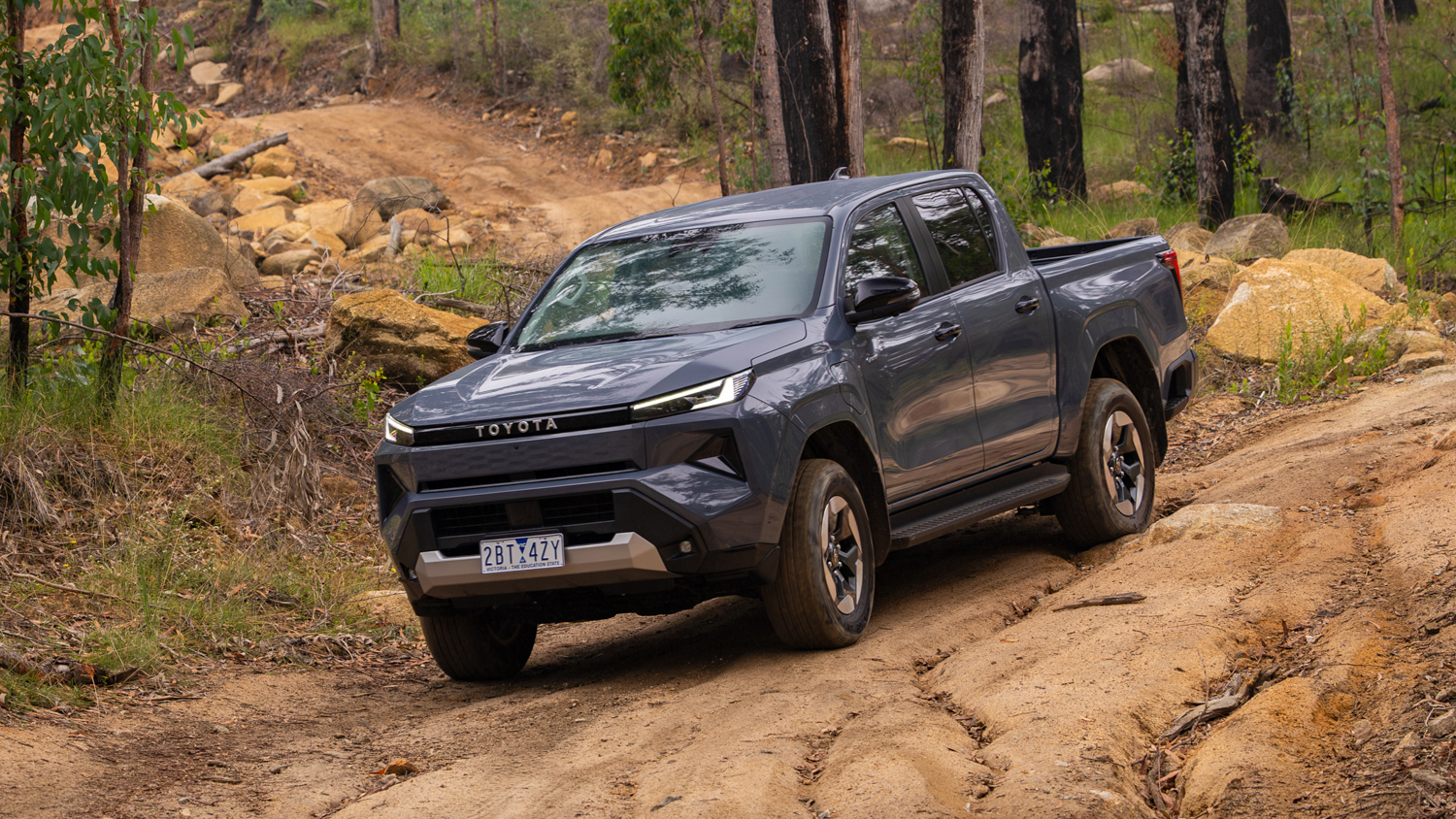
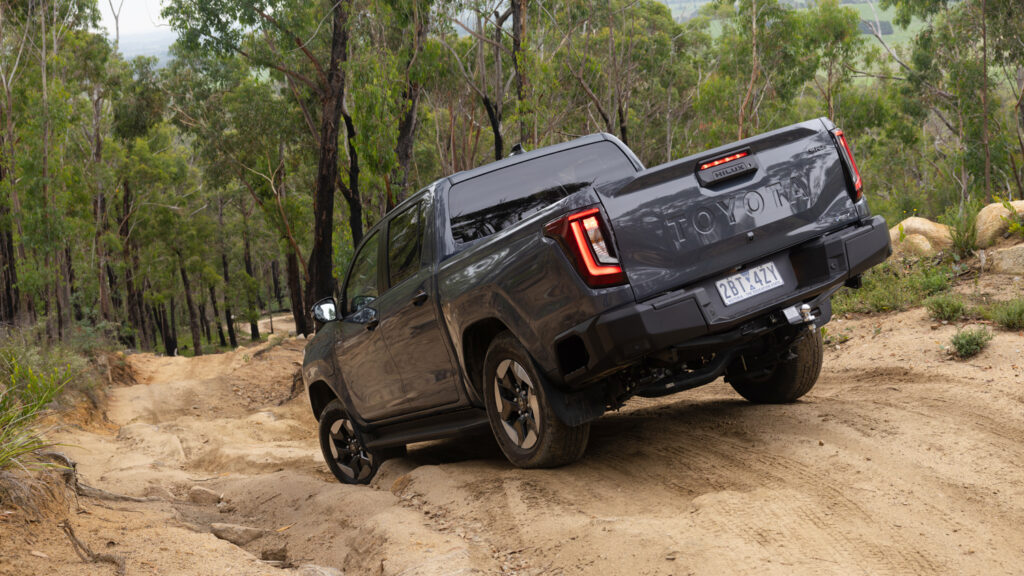
It’s why the HiLux BEV – Toyota’s first body-on-frame electric ute – has been deliberately built for a niche section of the market – predominantly mining fleets – rather than as a diesel replacement.
Munday said the goal was never to match a diesel HiLux or LandCruiser in low-range, heavy-duty conditions.
“The goal wasn’t to be able to match all of the low range, heavy duty kind of use of a diesel in all conditions,” said Munday.
“If you are going to be doing, like if you’re a park ranger that’s driving through deep mountain passes all the time, this isn’t the target for what we’ve been developing for.”
The biggest issue is range – or lack thereof.
The HiLux BEV’s modest 59.2 kilowatt-hour battery sits inside the chassis rails with a dedicated air gap and full underbody protection, a design choice Toyota says is necessary for durability but one that also limits how much usable battery volume can be packaged into the vehicle.
Solid-state batteries are the next real step change, and Toyota has been talking about the technology for well over a decade.
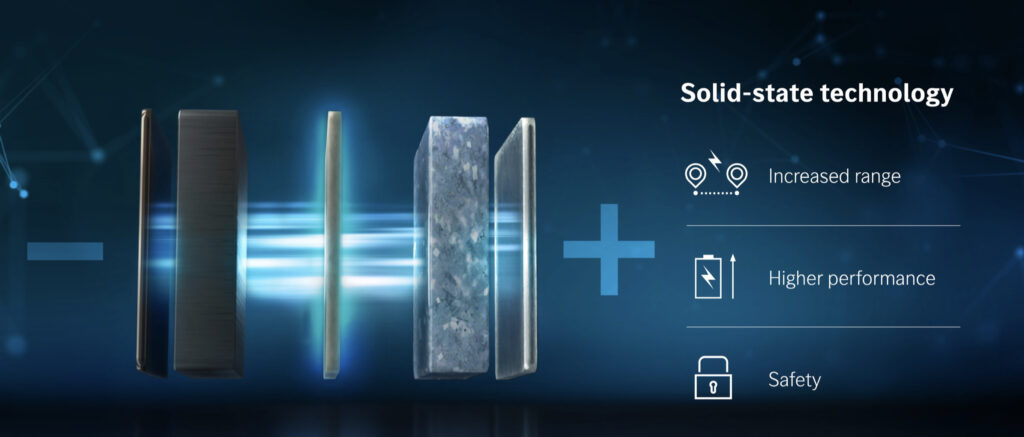
Toyota said last year it is still on track to introduce its first solid-state batteries into production vehicles within the next couple of years, most likely landing around 2027 to 2028 (expect it in larger, more expensive vehicles first, possibly including Lexus models).
But even that leap, according to Toyota’s engineers, won’t be enough to make a fully electric ute or 4WD a genuine diesel replacement.
“That will be a stepping stone,” Munday said of solid-state batteries.
“For full replacement of diesel, it’s probably the next generation after that even.”
“Even that’s not a full jump needed, but it will make a big difference.”
In other words, the batteries widely tipped as the EV industry’s next big breakthrough are, by Toyota’s own admission, just one step on a much longer road – and a vehicle capable of properly replacing a diesel HiLux or LandCruiser is likely two battery generations away.
Hydrogen offers a different route around the same problem.
Toyota confirmed the HiLux FCEV – its hydrogen fuel cell ute – remains on track for 2028, running similar motors and architecture to the HiLux BEV already on sale.
The advantage of hydrogen, Toyota says, is that it sidesteps the weight and packaging penalty of a large battery altogether.
“The advantage with fuel cell definitely is the weight,” said Munday.
“Fuel cell offers those advantages of being able to store a lot more energy, which then starts to break the range challenge.”
If that architecture proves itself in a HiLux, the same case applies even more strongly to LandCruiser and Prado, where towing and payload are non-negotiable and battery-only options don’t appear to be in the medium term frame for Toyota.
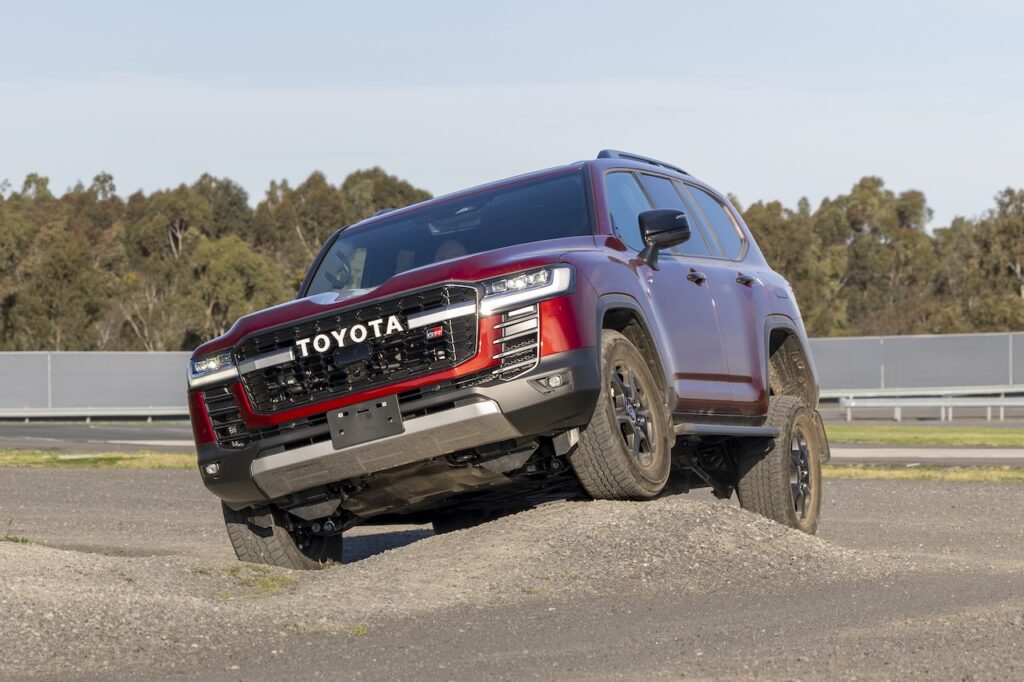
Toyota has separately confirmed a fuel-saving efficiency hybrid LandCruiser isn’t happening any time soon because towing performance drops once the battery depletes – a limitation hydrogen doesn’t share.
Toyota hasn’t confirmed a fuel cell LandCruiser or Prado, but the powertrain rationale driving the HiLux FCEV points squarely at exactly the vehicles that need it most.
Don’t expect hydrogen to go mainstream quickly, though.
Toyota was blunt about hydrogen’s infrastructure problem when pressed on when a fuel cell vehicle might sell in serious volumes.
“There’s far less infrastructure when it comes to hydrogen in Australia,” said Munday.
“We already know that BEV struggle infrastructure-wise, and now we’re talking about a totally new technology in hydrogen, so that’s further behind.”
Toyota also confirmed it has walked away from using hydrogen in a conventional internal combustion engine for production cars, a technology it has been trialling in motorsport for several years.
Toyota’s liquid hydrogen-fuelled GR Corolla H2 Concept has raced in Japan’s Super Taikyu series for four years, a GR Yaris Rally2 H2 Concept ran demonstrations at this year’s Rally Monte Carlo, and Toyota ran demonstration laps of a liquid hydrogen TR LH2 racing prototype earlier this year.
But as a production technology, hydrogen combustion is done.
“That was a trial programme,” said Munday of the Hiace development vehicle that used a converted 3.5-litre twin turbo V6 to burn hydrogen – for modest outputs.
“The fuel cell – all the feedback from our customers is that’s the product that people want.”
Toyota didn’t spell out exactly why it dropped hydrogen combustion for road cars, but as well as the obvious issue around a lack of refuelling infrastructure there’s also the challenge around efficiency .
Burning hydrogen in a conventional engine is inherently less efficient at turning stored energy into forward motion than a fuel cell’s electrochemical process – and it does nothing to solve the refuelling infrastructure gap that’s already the biggest handbrake on hydrogen’s rollout.
With two hydrogen technologies to develop and limited refuelling stations to support either, backing the more efficient of the two makes for a straightforward business case.
For now – and for most buyers – diesel remains the drivetrain weapon of choice.
The only tech seriously challenging that is plug-in hybrid, something that is ramping up in outright sales and also the number of offerings.