Game changing semi-solid-state battery arrives: Li-Mn has the potential to make 1000+km long-range EVs common
Another week, another claimed breakthrough from China’s fast-moving battery sector, as FAW reveals what it describes as the world’s first lithium-manganese (Li-Mn) liquid semi-solid-state battery.
Developed by FAW New Energy in collaboration with Nankai University, the new chemistry is said to deliver an energy density of up to 500Wh/kg at cell level — a significant jump over the roughly 250–300Wh/kg typically achieved by today’s ternary lithium-ion batteries.
While still short of the theoretical 800Wh/kg often cited for next-generation all-solid-state batteries, the figure — if validated in production-ready form — would represent a meaningful advance in battery performance.
READ MORE: Power up: BYD developing 1500kW chargers; Australian 1MW-plus launch plan under development
READ MORE: The most important new EV to be launched in 2026? And it’s unlikely to ever be sold in Australia
READ MORE: EV cancer risks: Real-world study delivers verdict on battery electric electrosmog health threat
According to FAW, the new battery could enable EV driving ranges of at least 1000km. However, as is typical with Chinese manufacturers, that figure is likely based on the CLTC test cycle, which tends to produce more optimistic results than Europe’s WLTP standard.
Helping the Li-Mn semi-solid-state battery achieve its claimed performance is what FAW describes as a ‘hybrid’ architecture incorporating solid electrolyte interfaces and composite electrolyte technology. The company also highlights an in-situ-formed lithium negative electrode, which it says improves energy density while enhancing cell-level safety.
Unlike conventional nickel-rich lithium-ion chemistries used by many current EV makers — including Nio, Geely and Chery — FAW’s approach centres on a manganese-rich cathode formulation. The pack itself is expected to be offered in capacities of up to 142kWh and is aimed at mid- and large-size electric vehicles.
FAW says it has also developed its own dedicated thermal management system and power electronics to support the new battery architecture.
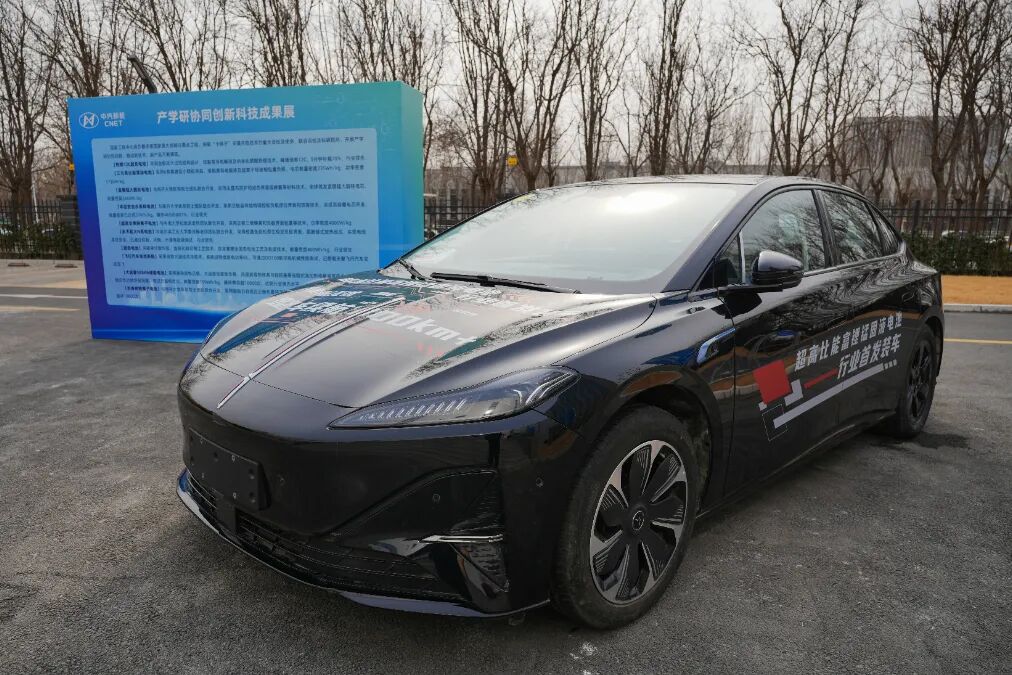
Real-world demonstration vehicles equipped with the Li-Mn semi-solid-state pack are expected later this year, though no firm production timeline has been confirmed. The company claims future iterations of the technology could extend driving range to as much as 1600km.
Alongside the new battery chemistry, FAW also announced a cloud-based battery management system scheduled to debut this year, with the potential for broader rollout across its EV portfolio.