

Banned! Popular EVs from Tesla, BYD caught out by power restrictions in Australia
Batteries and electric motors are making electrified vehicles too fast for novice drivers, at least in some parts of the country.
Two of Australia’s most popular EVs are now banned for P-plate drivers because they are deemed too powerful.
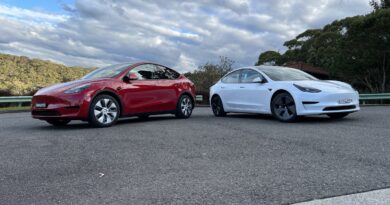
The heavily updated Tesla Model Y is not approved for P-platers in NSW and Victoria, and appears to breach the regulations in Queensland and South Australia.
And the BYD Shark 6 ute is banned for P-platers in NSW.
READ MORE: BYD Shark 6 review
READ MORE: Tesla Model Y Rear-Wheel Drive review
While P-platers were previously prohibited from driving the more powerful Long Range or Performance variants of the Model Y, even the entry-level Rear-Wheel Drive version is now deemed too powerful, so is also banned.
The issue comes down to a power-to-weight ratio limit of 130kW per tonne. Any vehicle exceeding that is not approved for use by P-platers (learner drivers can drive anything because they have an experienced driver instructing them).
According to Australian certification documents the Model Y Rear-Wheel Drive’s tare mass is 1921kg and its power is 255kW (Tesla quotes different figures in its owner’s manual but says the discrepancy comes down to the testing methodology).

That gives it a power to weight ratio of 132.7kW/tonne, just breaching the 130kW per tonne limit. According to Redbook that means it’s not approved in four of eight states and territories.
Prior to the 2025 update, codenamed Juniper, the Model Y RWD had a power to weight ratio of 115.2kW/tonne.
Tesla Australia country director Thom Drew said it was “unfortunate” the Model Y was no longer approved for P-platers in most of the country, something that could be an understatement considering the popularity of the mid-sized SUV.
Last month the Model Y was the fourth best-selling car in Australia and the second-best selling SUV, outdone only by the Toyota RAV4.
And in 2024 the Model Y was the eleventh best-selling car, eclipsing vehicles such as the Hyundai Tucson, Toyota Camry, Mazda CX-3 and Subaru Forester.
“It’s not something we can alter at this point but we can potentially review it (in future),” said Drew when asked if there was the potential for a software update with a reduced power mode.
“The volume of people in that scenario is relatively small … but there’s enough of a concern to help us make a case for it (with engineers at head office).”
He suggested a dedicated P-plate driving mode wasn’t quite as simple as writing new software code because it would also require the car to be recertified for Australian Design Rules.
“It is something we briefed the team on, but it is more complex than it sounds. We’d need to homologate a whole new version of the car.”
The BYD Shark 6 is another electrified vehicle that has been caught out by the P-plate restrictions.
The plug-in hybrid dual-cab ute uses two electric motors and a 1.5-litre four-cylinder turbocharged petrol engine to produce up to 321kW of power, about double the output of most diesel utes.
It’s heavier than most utes at 2675kg (the brochure states 2710kg but the certification documentation lists it as 2675kg), something that helps its case in most parts of the country. That gives it a power-to-weight ratio of 120kW/tonne.

While they should mean it’s approved for P-platers around the country, NSW lists the Shark 6 as “banned”.
As well as the power to weight ratio rule NSW also says it can ban “other vehicles classified as high performance”.
It appears the Shark 6’s claimed 0-100km/h time of 5.7 seconds may have piqued the interest of regulators in the country’s most populous state (we sent a media query to Transport NSW but never received a response).
The CEO of BYD importer EV Direct, David Smitherman, was unfazed by the classification, stating “we’ve got bigger fish to fry”.
“I think it’s a positive because it shows our vehicle has significant performance and it dispels the notion that new energy vehicles lack performance and aren’t up to scratch compared with diesels.”
Just because a vehicle is not approved for use by P-platers doesn’t mean there aren’t exceptions to the rule.
The states offer exemptions, such as when drivers don’t have access to other vehicles in the family or you need the vehicle to perform certain duties, such as driving to and from work.
However, those exemptions typically require additional paperwork and approvals.
Just like many powerful cars.
If a 18 year old has a Tesla or byd then rich mummy and daddy has brought it for them
This has always been the case for V8 and a lot of performance 4’s and 6’s in Australia. The title of article is misleading badly.
imagine buying a Ferrari or Lamborghini that has power limitations. What’s the point of buying them?