Light speed: Ferrari Luce named, as Italian supercar-maker continues drip-feed reveal of its pioneering EV
Ferrari’s first-ever EV will be called the Ferrari Luce and will feature an iPhone-inspired cabin when the 1000bhp (746kW) battery-electric four-door GT makes its global debut this May.
Employing the Italian word for ‘light’ — previously used by Mazda for its Luce sedan (produced from 1966 to 1991) — the Italian supercar maker has already shown off some of the advanced hardware that lies beneath the skin of its high-end Porsche Taycan rival. Now it’s time to take a peek inside.
Said to have taken five years to develop, Ferrari’s new zero-emissions chapter has seen the firm team up with two design heavyweights — former Apple design chief Jony Ive, who oversaw iconic products such as the iPhone, MacBook and Apple Watch, and Australian industrial designer Marc Newson.
READ MORE: Secrets of Ferrari’s first EV revealed! 1000hp high-performance Elettrica SUV shapes up ahead of 2026 launch and 2027 Aussie debut
READ MORE: 2025 Ferrari 296 GTB Review: Flat-out in EV mode in a ballistic V6 hybrid Italian supercar
READ MORE: Fazzin’ hell! The new Ferrari F80 has nine electric motors and it’s not even an EV!
Refreshingly, while some might have expected a soulless cabin dominated by touchscreens, both designers have looked to the past in order to move forward.
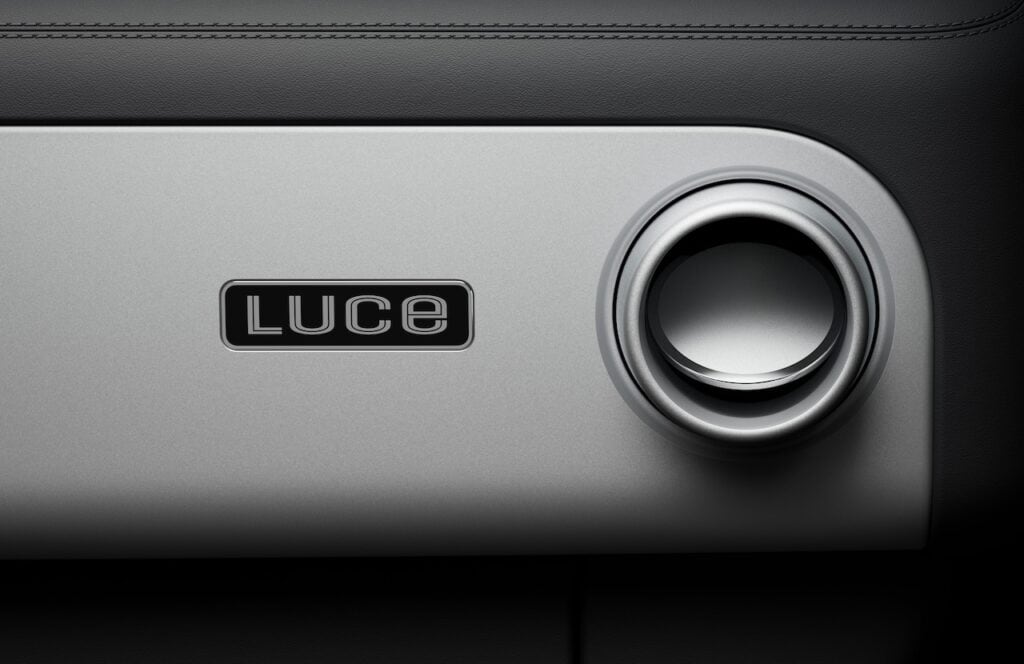
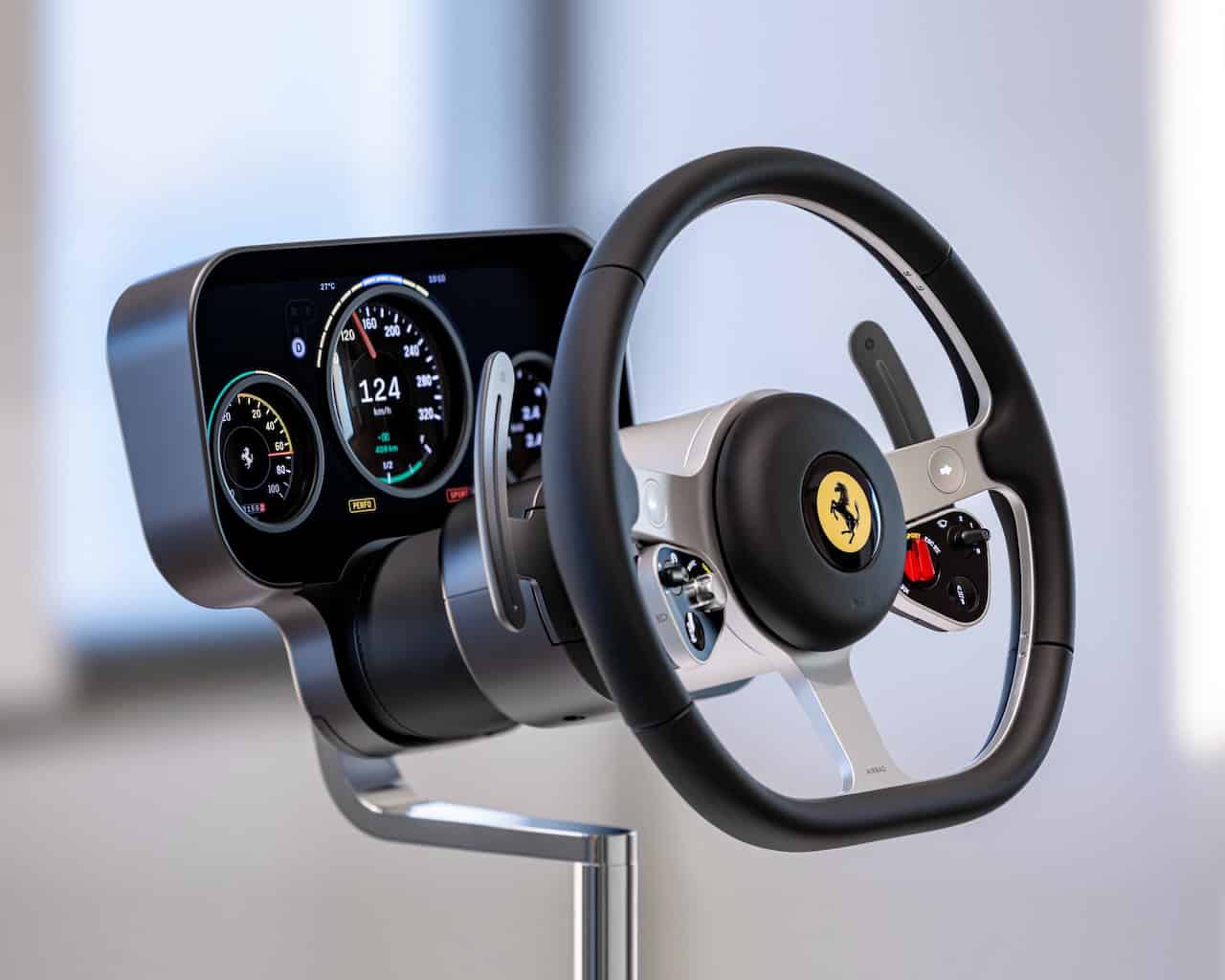
That explains why the steering wheel resembles the classic Nardi wheels used in the 1950s and 1960s. It is made from machined aluminium and features two proper physical buttons for the indicators.
Ahead of the driver sits a traditional-style dashboard with a binnacle cluster mounted to the steering column that moves when the wheel is adjusted.
Although it appears to feature three analogue clocks, the instrument panel is actually formed by twin 12.5-inch OLED screens that create a clever three-dimensional effect, with the top layer featuring cut-outs that reveal the lower display. A neat touch is the return of a proper needle-style graphic for the digital speedometer.
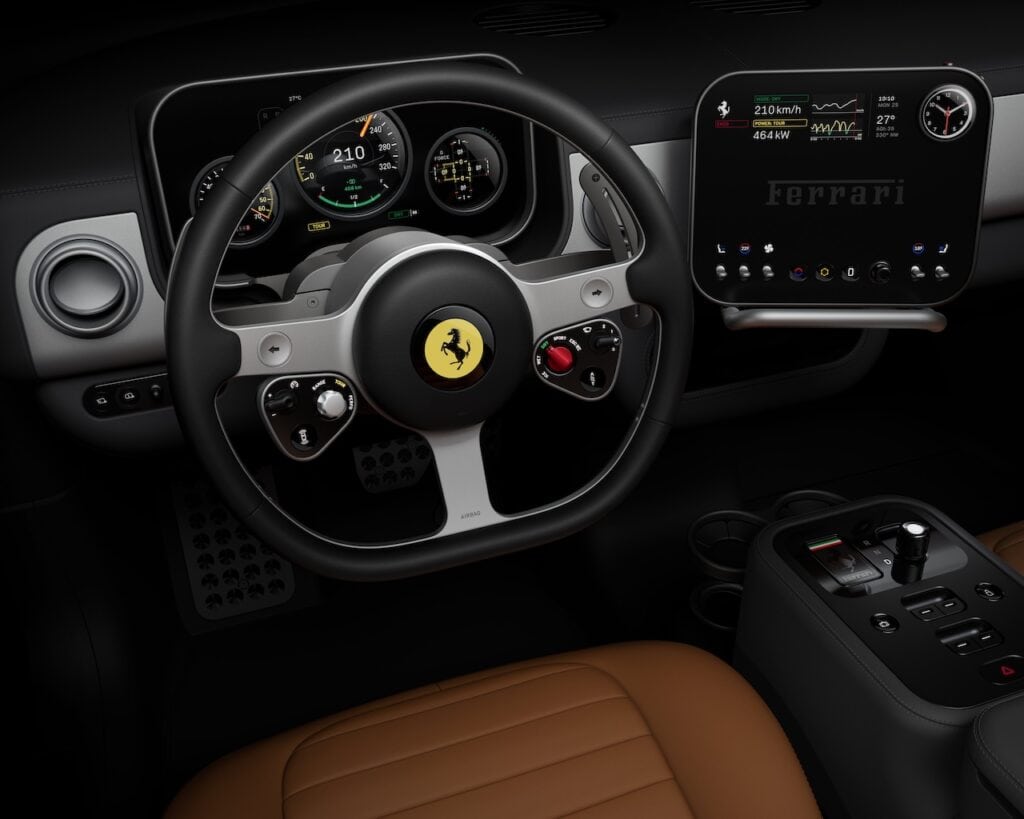
Emulating classic dials, the displays are said to offer watch-like clarity inspired by Ferrari’s 1950s instruments.
The main 10-inch display rotates toward either the driver or passenger and incorporates a clock in the top right-hand corner, said to mimic a mechanical timepiece.
Pleasingly, there are also physical toggle shortcuts for the screen, with an emphasis on tactility.
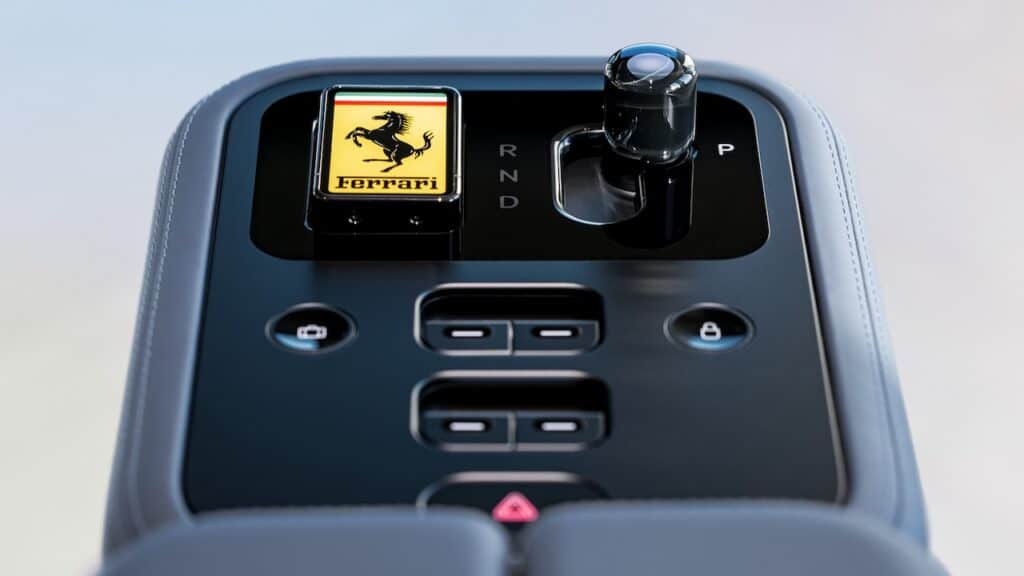
More old-school thinking sees the return of Ferrari’s physical square key, which has its own dock within the glass-crystal centre console.
The clever twist is that the key uses new e-ink technology, changing colour when it is safely docked. The key turns black, with the traditional yellow hue visually “transferring” to the drive selector.
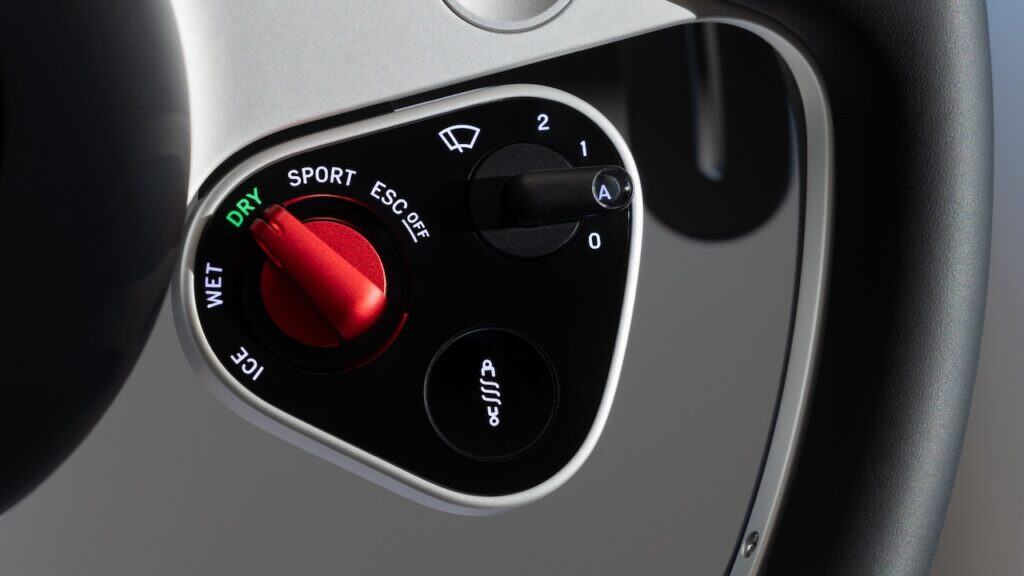
A steering wheel-mounted manettino for the three electric driving modes, along with powertrain settings and a pair of torque-managing paddles, are also included.
Rear passengers are treated to their own touchscreen displaying a speedometer, track timer and additional information.
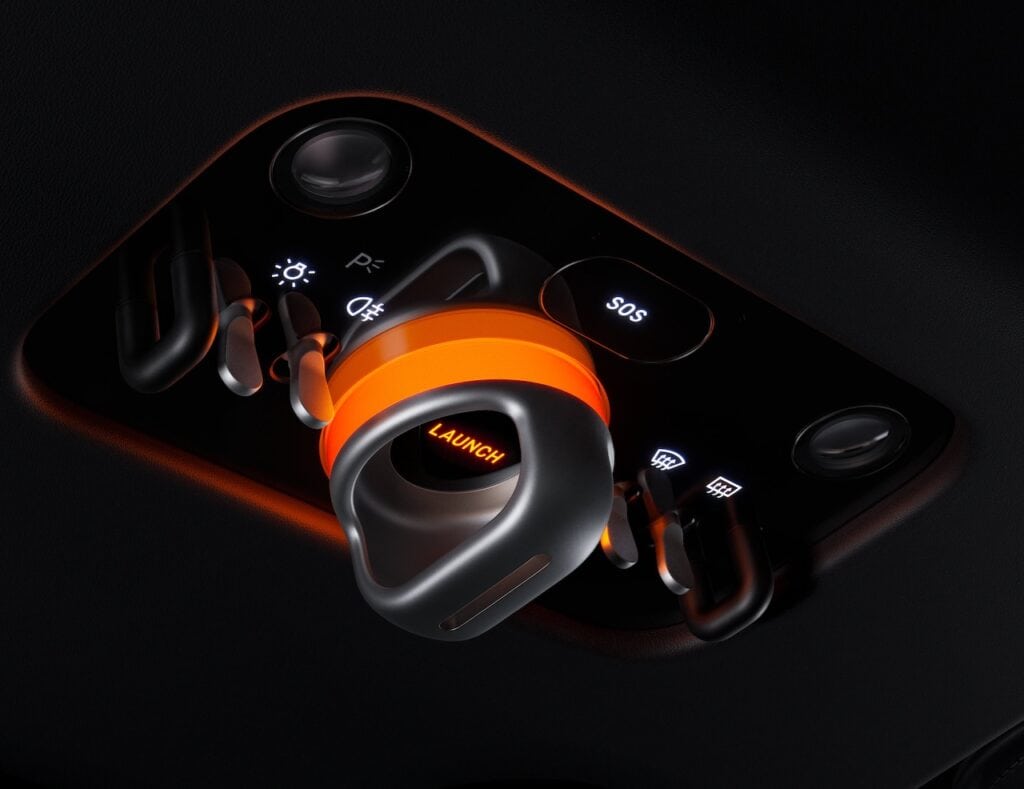
Above the centre console sit roof-mounted controls for the headlamps, launch control and front and rear fog lights. Launch control is activated by pulling down on a grip, replicating controls used in helicopters.
High-quality finishes throughout the cabin include liberal use of anodised aluminium and glass in place of plastic. Ferrari says glass is stronger and perceived to be more luxurious, although it adds around 10kg in weight.
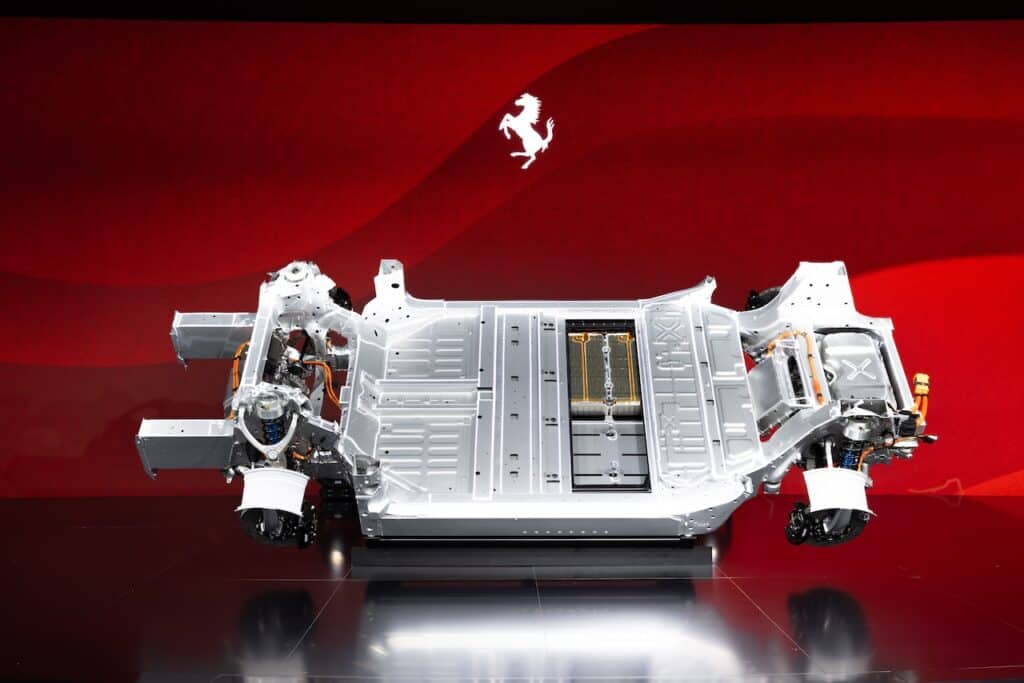
Earlier teasers of what was prewviously known as Elettrica revealed the four-door, four-seat crossover will be based on an all-new aluminium architecture developed to underpin Ferrari’s first battery-electric vehicle.
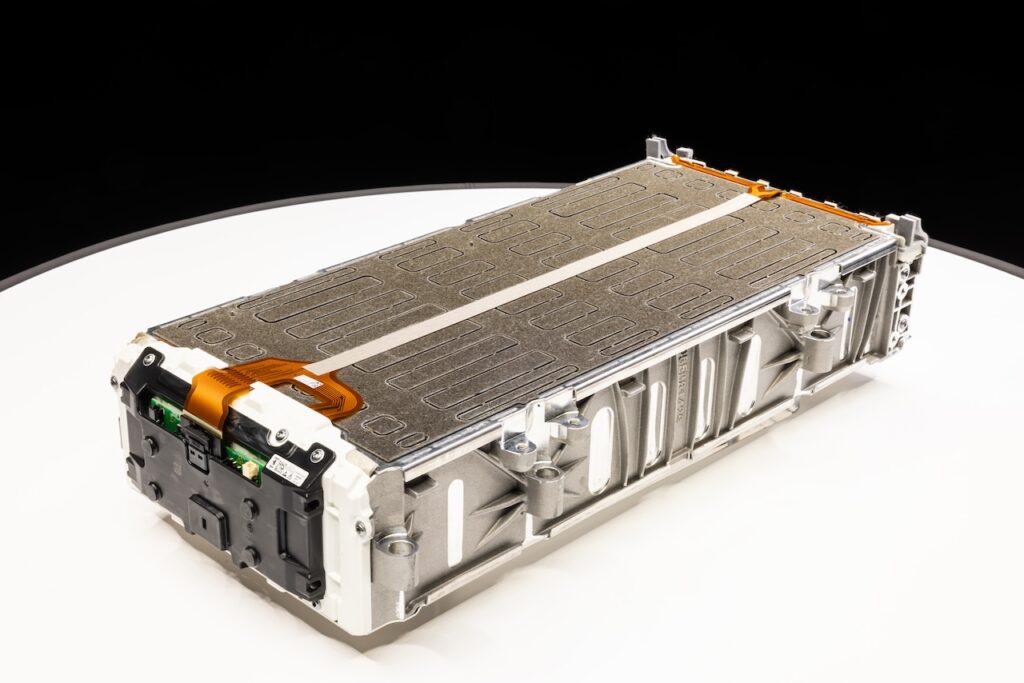
A large 122kWh battery sits between the front and rear axles and uses pouch cells sourced from Korea’s SK On, with a claimed energy density of 195Wh/kg.
The weight of the battery is expected to limit driving range to around 530km on a single charge, but the use of powerful 880-volt electrics enables DC charging at rates beyond 350kW, with a 10–80 per cent top-up taking around 25 minutes.
With peak power from four electric motors expected to exceed 1000bhp (746kW), the Luce is tipped to sprint from 0–100km/h in just 2.5 seconds and reach a top speed of 310km/h.
Other highlights of the new EV — which will rival the production version of the Lamborghini Lanzador and the forthcoming battery-powered Bentley “Urban SUV” — include F80 hypercar-derived roll-cancelling active suspension and rear-wheel steering to boost agility.
Finally, the new Ferrari EV is expected to feature its own authentic soundtrack, using electric guitar-style pick-ups integrated with the rear e-axle inverter to amplify the sound of the electric motors during acceleration and braking.
Additional theatre comes via virtual gearshifts operated by the paddles.
There’s no word yet on pricing for Australia, but the new Ferrari Luce is expected to sit at, or slightly below, the $900,000 Purosangue SUV.