
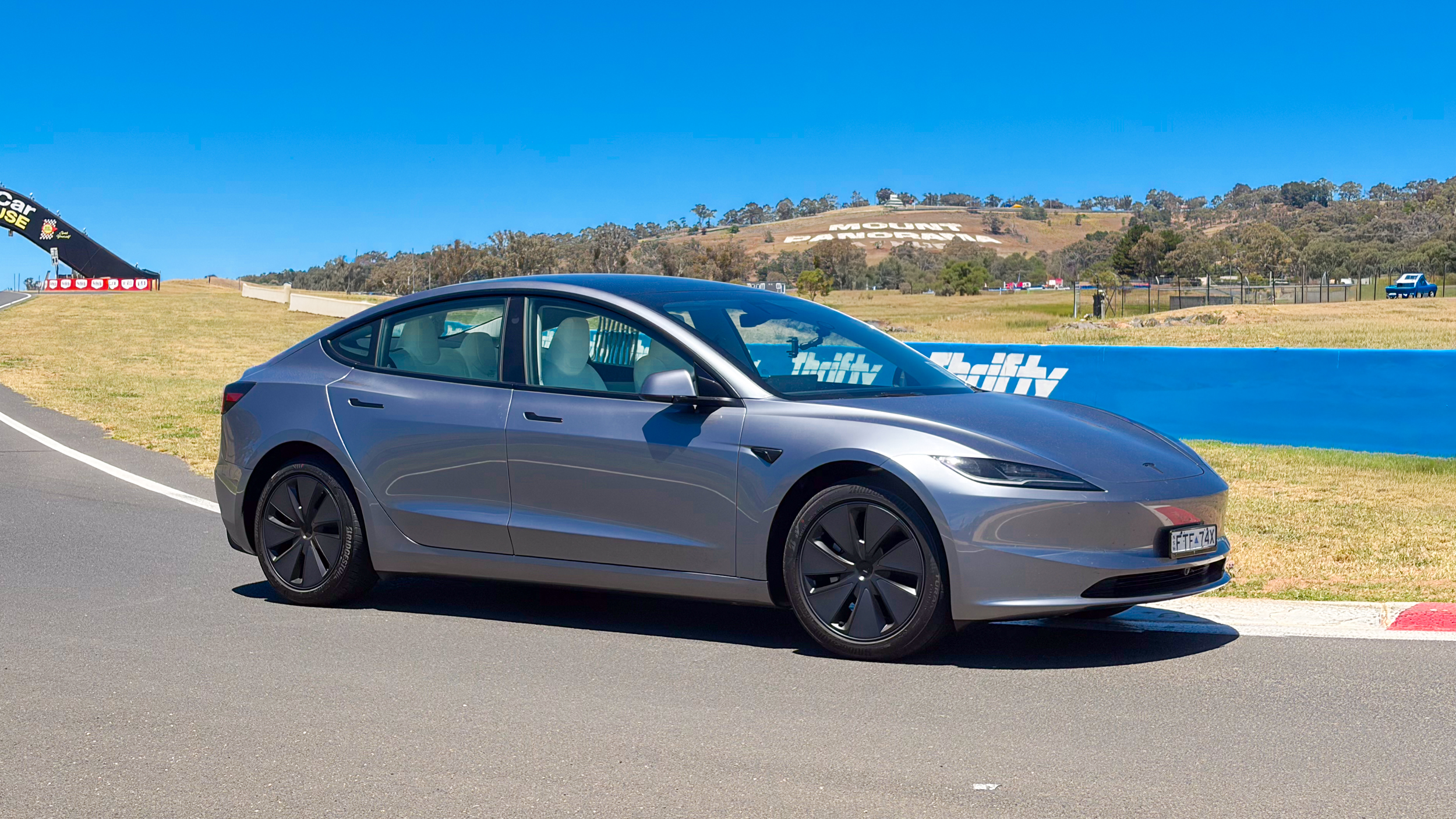
2026 Tesla Model 3 Long Range Rear-Wheel Drive Review: Tesla’s longest range EV yet, but should you sign up for the journey?
Less power and two fewer wheels doing the driving.
It’s not exactly a scorching sales pitch, although to be fair that brief summary misses the real headline: it’ll travel further on a charge.
Up to 750km, according to the WLTP test cycle.
Yep, the Tesla Model 3 Long Range scored an upgrade late in 2025 that means it now has less power but can travel further between charges.
READ MORE: Range buster! Tesla Model 3 Long Rear-Wheel Drive launches with 750km range, AWD dropped
READ MORE: Telsa Model Y Performance Review: More aggro and a heck of a lot more pace, but is this EV hero worth the extra bucks?
READ MORE: 2025 Tesla Model 3 Full Self-Driving (Supervised) Review: Everything you need to know about the Tesla that drives you
READ MORE: New Tesla Model 3 Long Range crushes rivals with 830km range! Time to start the campaign to get it into Australia!
READ MORE: 400,000km Australian Tesla Model 3 goes viral with 90% health remaining on its original battery
The middle model of the three-tiered Model 3 line-up loses its front motor and some off-the-line excitement.
But the payback is the longest range of any EV currently on the market – 750km – and a sharper price tag.
2026 Tesla Model 3 Long Range Rear-Wheel Drive price and equipment
Five years ago the Tesla Model 3 Long Range was a premium product playing very much in the luxury space. At one stage it was priced from $89,514 plus on-road costs.
These days the Model 3 Long Range Rear-Wheel Drive – as it’s now known – is $61,900 plus on-roads.
That’s a fair drop and is also $3000 cheaper than the model it replaces.
It’s the cheapest a Model 3 Long Range has ever been.
As before, there’s a heap of gear, although the Long Range now only matches the Rear-Wheel Drive for its core feature set.
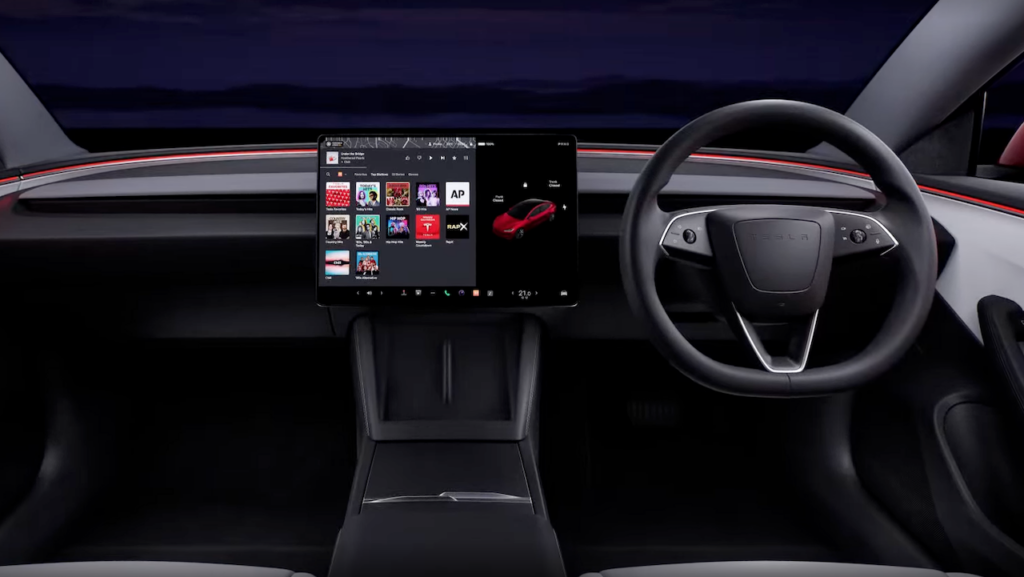
The two share the same 18-inch wheels (you can option 19s but the range drops to 691km) and get a panoramic sunroof, matrix LED high beams, heated front and rear outboard seats, ventilated and electrically adjustable front seats, a powered tailgate and a 15.4-inch central touchscreen that packs in plenty of gadgets and gismos.
They include a built-in dashcam to arcade games and a camping mode that keeps the AC running when parked.
It’s also got one of the best connected apps in the business, allowing a phone to be used as a key and keeping the owner in contact with the car; you can even remotely monitor the cameras to see who or what is around the vehicle in real time.
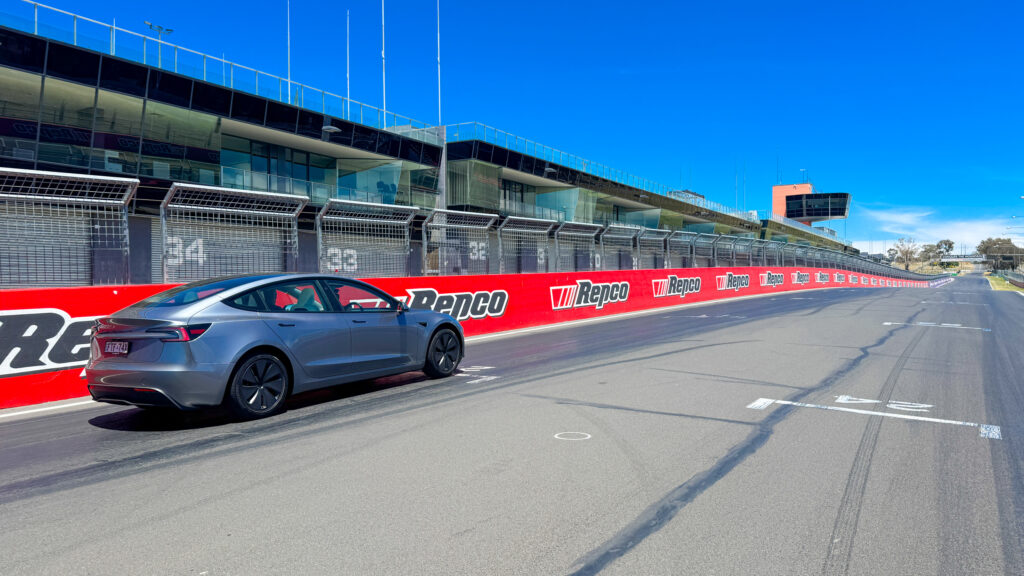
One of the best new additions – or returns – for the Model 3 is the indicator stalk.
Gone are the frustrating buttons on the steering wheel and in is a more traditional stalk that’s more natural to use and way easier mid-corner.
The updated Long Range does step backwards in one area: its sound system.
Whereas it previously shared its premium audio system – complete with subwoofer – with the top-of-the-line Performance model, it’s now reverted to the more basic system in the Rear-Wheel Drive.
That means thoroughly decent audio, but not the pumping system that was standard before.
Of course, the battery is also a big part of the feature set for the Model 3 Long Range – and it gets better with this update.
While Tesla doesn’t quote battery capacities, overseas reports suggest the latest update has added another few kilowatt-hours for a total of somewhere between 78kWh and 82kWh.
While the base Model 3 Rear-Wheel Drive uses a lithium-iron phosphate (LFP) battery, the Long Range gets an NMC (nickel manganese cobalt) battery similar to that used in the Performance model.
That means better energy density but a battery that is typically more expensive to manufacture; and like all NMC batteries it’s recommended you only top up to 100 per cent ahead of a road trip.
Like all Teslas, one thing that is missing is Apple CarPlay and Android Auto connectivity.
Instead, there are embedded apps that give you much (but not all) of the functionality from those third-party systems.
Good news is the warranty for all Teslas in Australia has juxt been upgraded from a sub-standard four years and 80,000km to five-years and unlimited km. The battery remains covered by a separate eight-year, 192,000km warranty.
As for how much power it makes, there’s a bit of guesswork because Tesla doesn’t quote power figures.
However, certification documentation suggests it now uses the 3D6 rear electric motor that was previously used in the Model 3 Performance (that car now picks up a new 4D2 rear motor and combines it with a front motor codenamed 3D3).
That same certification documentation suggests it makes 235kW (there’s no torque figure), however delving into the owner’s manual in China (where the car is made) suggests the 3D6 motor makes 220kW and 440Nm.
2026 Tesla Model 3 Long Range Rear-Wheel Drive: What we think
There was already lots to like with the Tesla Model 3 and the Long Range Rear-Wheel Drive dishes up most of that.
Its relatively quiet and comfortable and the suspension nicely soaks up bumps.
Plus it’s agile and has a well-controlled body, which makes driving easy from the country to the city.
The five-seat body is deceptively spacious. Occupants are well looked after in the cabin (although hot, sunny days can feel a tad microwave oven with the unshielded glass roof) and there’s loads of useful storage, including a frunk and a boot with a deep underfloor cavity.
We briefly tried Full Self-Driving (Supervised) but found it too frustrating on the open road.
Sure, it does an impressive job of doing most of the driving.
But no matter what settings I activated it was inconsistent in sticking to the speed limit. It’d often trundle around 10-15km/h below the posted limit.
So I reverted to regular cruise control and took over the wheel.
As for performance, yes it’s slower than the model it replaces. But it’s a long way from slow.
It’s claimed to hit 100km/h in 5.2 seconds and it certainly feels zippy.
Even on the open road there was plenty in reserve to blast past a truck or have a bit of fun through some twisties.
All of which is a tick for the move from two motors to one. The reality is many single-motor EVs have more than enough thrust, so adding some more range and reducing the price by deleting that front motor makes a heck of a lot of sense for a lot of people.
Speaking of range… The battery on the M3 LR is not huge – plenty of batteries these days surpass 100kWh – but it’s decent and combines with above-average efficiency to deliver impressively long range.
Its claimed 750km of range is longer than any other EV on the Aussie market (for now, at least) – and 121km longer than the AWD model it replaces.
And, no, we didn’t get 750km from it. But we were getting about 620km and are confident you could eke more out of it with gentler driving.
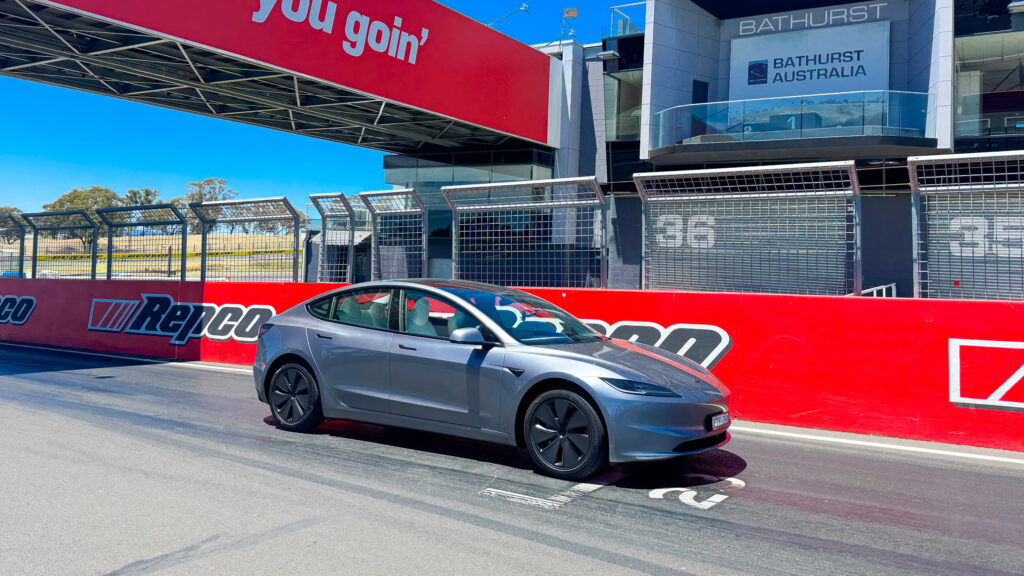
We also tapped into the Tesla Supercharging network, which is excellent.
For our 1000km trip we topped up a couple of times, each quick and easy.
For anyone wanting to tackle a road trip that’s a big deal.
2026 Tesla Model 3 Long Range Rear-Wheel Drive: Verdict
The Tesla Model 3 Long Range isn’t perfect, but it’s pretty good – and mounts a solid case to leave petrol behind.
It drives well, nicely integrates tech and is deceptively practical and easy to live with.
It’s also easy to charge and allows owners to tap into the terrific Tesla charging network.
That it can go further than any other EV on a charge adds to its appeal and makes it one of the more convincing EVs on the market.
At least for those prepared to look past the Elon factor…
Score: 4.5/5
2026 Tesla Model 3 Long Range Rear-Wheel Drive specifications
Price: $61,900 plus on-road costs
Basics: EV, 5 seats, 4 doors, sedan, RWD
Range: 750km
Battery capacity: 80kWh (approximately)
Battery warranty: 8 years/192,000km
Energy consumption: 12.5kWh/100km
Motors: 1 rear 220kW/440Nm
AC charging: 11kW, Type 2 plug
DC charging: 250kW, CCS combo plug
0-100km/h: 5.2 seconds
You have AC and DC charging the wrong way around.
>
AC charging: 250kW, CCS combo plug
DC charging: 11kW, Type 2 plug
Thanks Gordon, much appreciated for pointing that out.
The 2026 Tesla Model 3 Long Range Rear-Wheel Drive is a cost cutting exercise to refresh what is now a very stale car. We have two Tesla Model 3 cars in the garage. One is a 2019 Model 3 Performance with Enhanced Autopilot (EAP) and the other is a 2021 Model 3 RWD SR+ with Full Self Driving (FSD). Sadly, despite both cars stating they have a Full Self Driving Computer, being Hardware 3 (HW3) both cars are extremely dangerous to drive while under EAP or FSD. Phantom braking is an issue with both cars and both cars are unable to read overhead speed limit signs on either the old ring road or Melbourne’s new freeway system. The issue is parts of these freeways are multi-lane separated by concrete barriers. So, a merging lane on the other side of the concrete divider may show a 70 km/h speed sign which is clearly separate to the 100 km/h section of freeway I am on. However, when in the 100 km/h section both Teslas, whether on EAP or FSD will slam on the brakes to slow down to 70 km/h. This is so bad as cars behind me are not expecting a car to slam on the brakes on the ring road in light traffic for no reason! Another example of road terror is when a lane merges into the highway you are travelling on while using EAP or FSD. The usual protocol is the merging car will approach the highway and enter the highway behind the car in the left lane. However, our cars get nervous seeing a car to their left. even though the merging car will blend onto the highway behind our Teslas. So, what do our Teslas do? They slam on the brakes to avoid the merging car! This is the worst thing possible! Sure, humans will speed up a little to give the merging car more room to slip onto the highway behind you, but our Teslas act as if they are intent on creating a collision! Lastly, forget about entering a large completely visible roundabout. Both cars will scream at you with a red steering wheel icon to take over immediately. When driving any Tesla using some form of autopilot, EAP or FSD, we find it more stressful than supervising our children as they learned how to drive while on their L plates. We do like the autopark feature on our Teslas, yet both our previous cars had front facing cameras and genuine 360 degree birds-eye views to avoid curb rash. The fact that new Teslas still don’t have a heads up display (HUD) in 2026 is a joke. We never expect the EAP or FSD in our Teslas to deliver what we were promised. At $5000 and $10,000 for EAP and FSD respectively thousands of Aussie owners will also be burned. As for styling, we both covered the wood on our dashboards with black plastic covers that make our cars almost indistinguishable from the 2026 model you tested. Lastly, HW4/AI4 owners with FSD have never been promised their Teslas will be capable of true unsupervised self driving. So, until Teslas actually delivers on FSD, most likely on AI5, FSD will continue to be more hype than reality. The battery tech is both undersized and out of date as well. We do appreciate the Tesla Supercharger network, yet that’s now open to other brands. So it’s no surprise that Tesla’s market share looks likely to keep sliding as BYD and other Chinese brands genuinely pursue both innovation and value for money.