
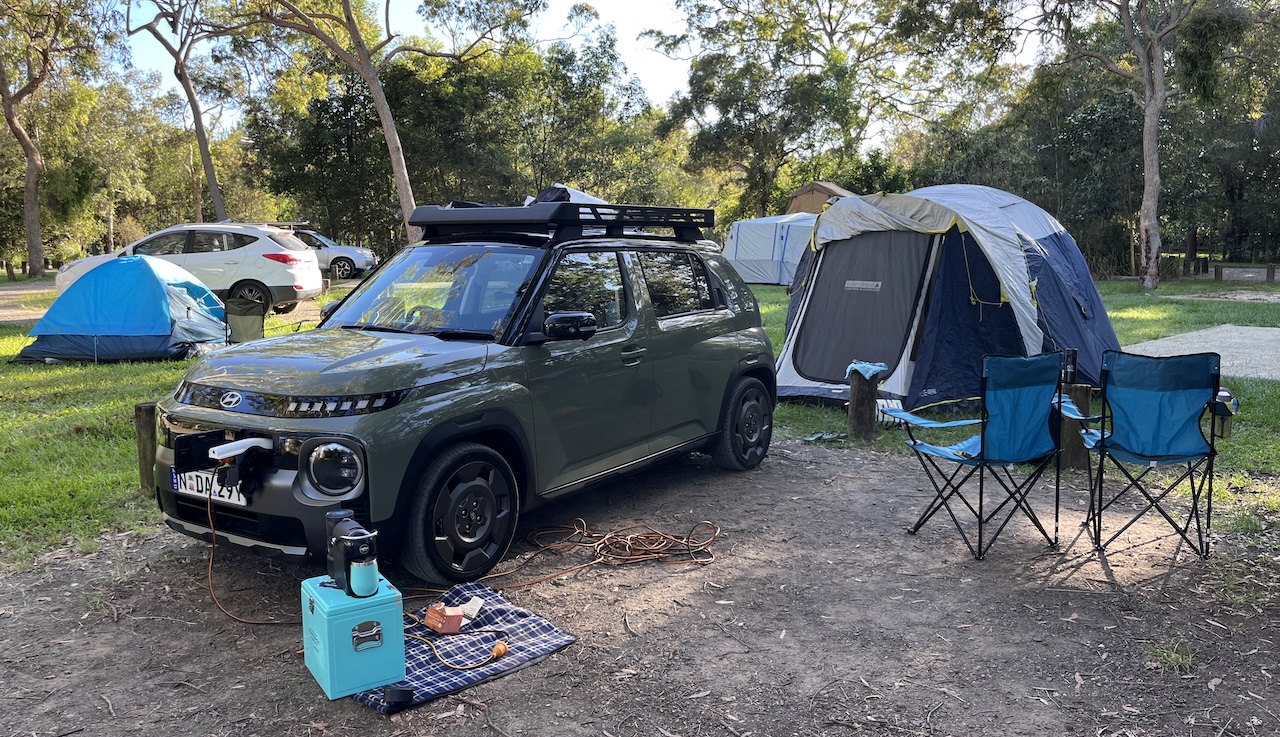
Want to go camping in your EV? We’ve done it: Here are seven things you must know before your first electric car sleep-over
I’m getting used to sleeping in cars.
No, the family’s not kicked me out. Nor has the house burned down.
Instead, my automotive overnighting is due to an electric car’s ability to become a mobile air-conditioned hotel room. Which is damn appealing during holiday time when even crummy motels are charging Park Hyatt prices.
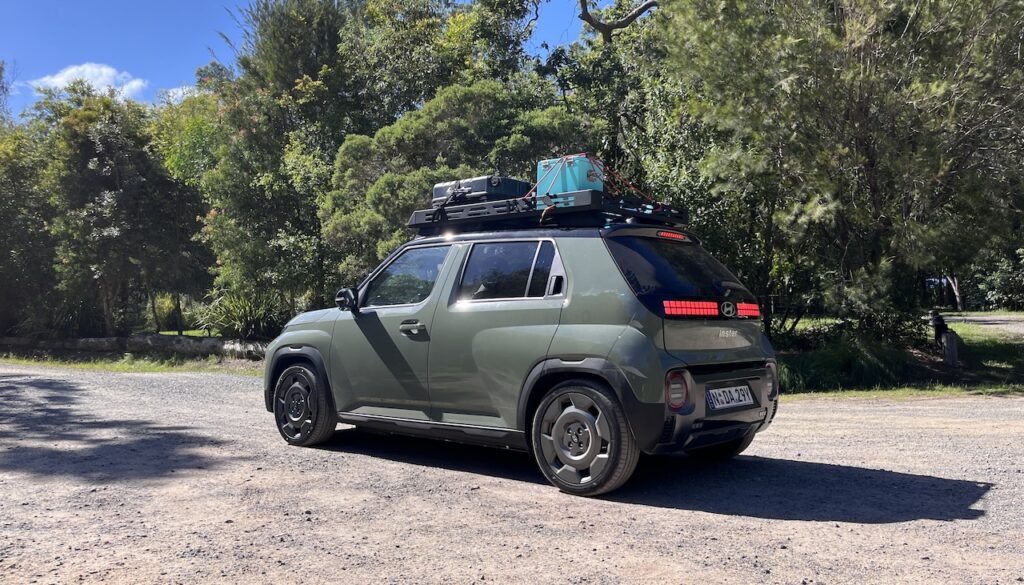
In recent weeks I’ve slept in two Hyundai EVs – a giant Ioniq 9 and the miniscule Inster Cross.
READ MORE: Mitsubishi Outlander PHEV test: Camping is depraved and should be banned.
READ MORE: Volvo EX30 X-Country: Do we need an EV soft-roader faster than a Porsche 911 GT3?
READ MORE: Radical electric Kia PV5 people mover and cargo van coming to Australia.
These SUVs offer vastly different cabin space and luxuries ($120,000 vs $45,000 will do that), but it transpires as long as you have enough space to fully stretch out, a good night’s sleep’s possible in both.
Here are my takeaways after car camping – once solo, once with the family in tow.
1. Check your car has a Camping / Sleeping / Utility Mode
This is key to a peaceful night’s sleep.
Check your EV’s owner’s manual or touchscreen menu to discover how to select a camping/sleeping mode. If no joy, Google, YouTube or Facebook groups give handy car model-specific tutorials.
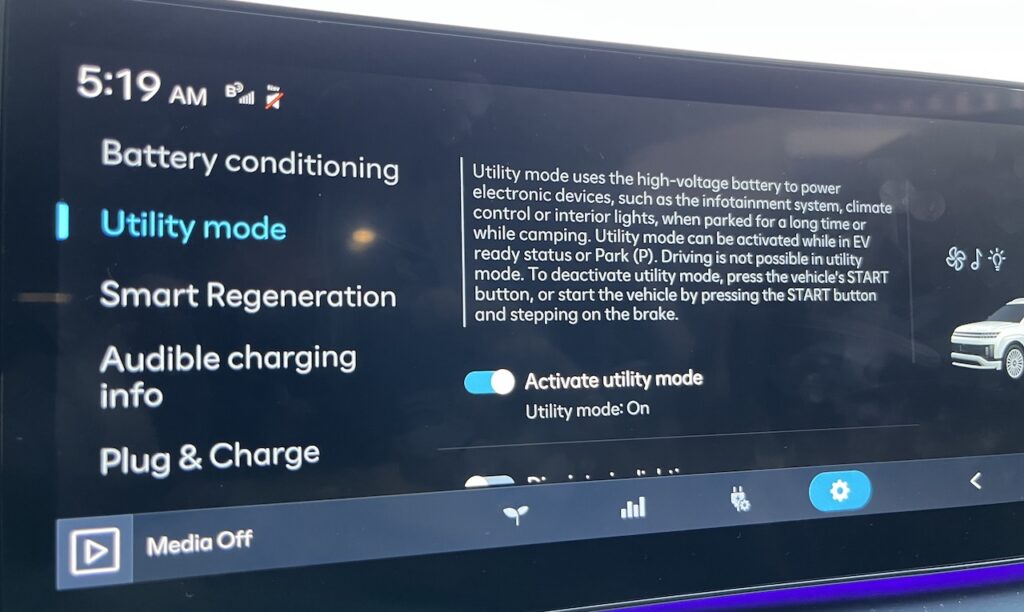
In this mode the car stays on (silently) while keeping climate control running through the night.
In the Hyundai’s case, it switches off all dashboard and display lights so you’re blissfully in the dark. But power remains on for charging your phone, laptop or fridge.
2. Ensure your EV battery has plenty of charge
This is a recommended, rather than an imperative.
My experience was the EV used very little battery charge when running air-con overnight, so don’t fret thinking you must start car camping with 90%+ battery if it’s just an overnighter.
Even so, range anxiety is very much a thing during your first EV sleep.
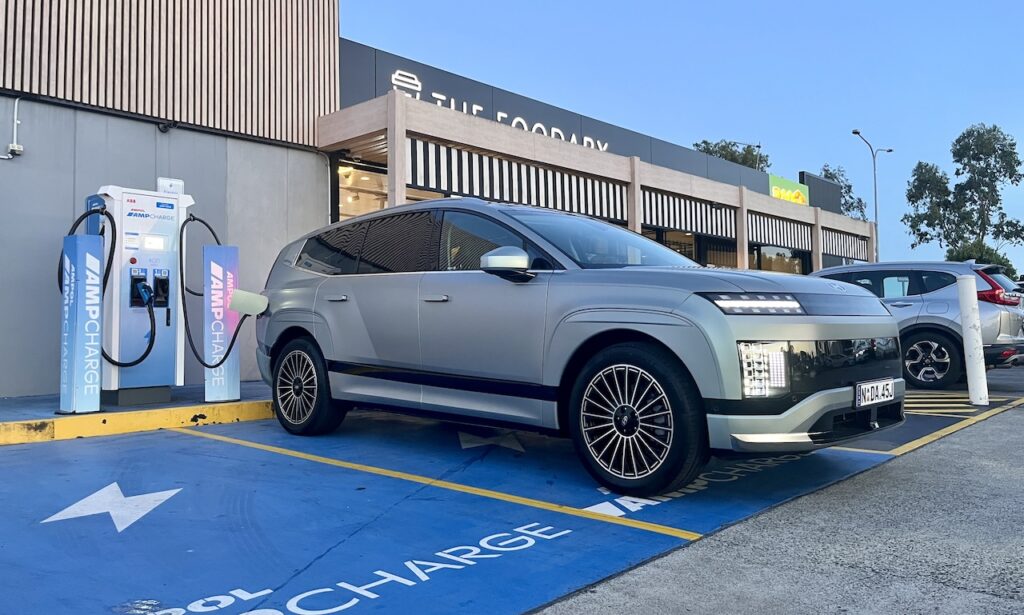
My findings were the Hyundai Ioniq 9 with its 110kWh battery dropped only 1% charge per hour of climate controlled kipping.
Conditions were favourable however. I was solo sleeping and set climate control to 22C, while the overnight outside temperature also hovered around 22C – that’s a Queensland summer for you.
The Hyundai Inster had a tougher task. Its 49kWh battery started its overnight work at 50%, and after eight hours running climate control at 23C (overnight temperature started at 28C and dropped to 17C), we awoke to see it at 36%… roughly 2% loss per hour.
3. Buy a car camping mattress
Fear not. This doesn’t have to break the bank.
Hop on Tesla’s website and it sells a perfect-fit blow-up mattress for the Model Y for $375, while aftermarket alternatives are manyfold, starting below $100.
Other brands – Hyundai included – appear slow to offer genuine accessory blow-up mattresses for their EVs.
The aftermarket snaps up this business instead.
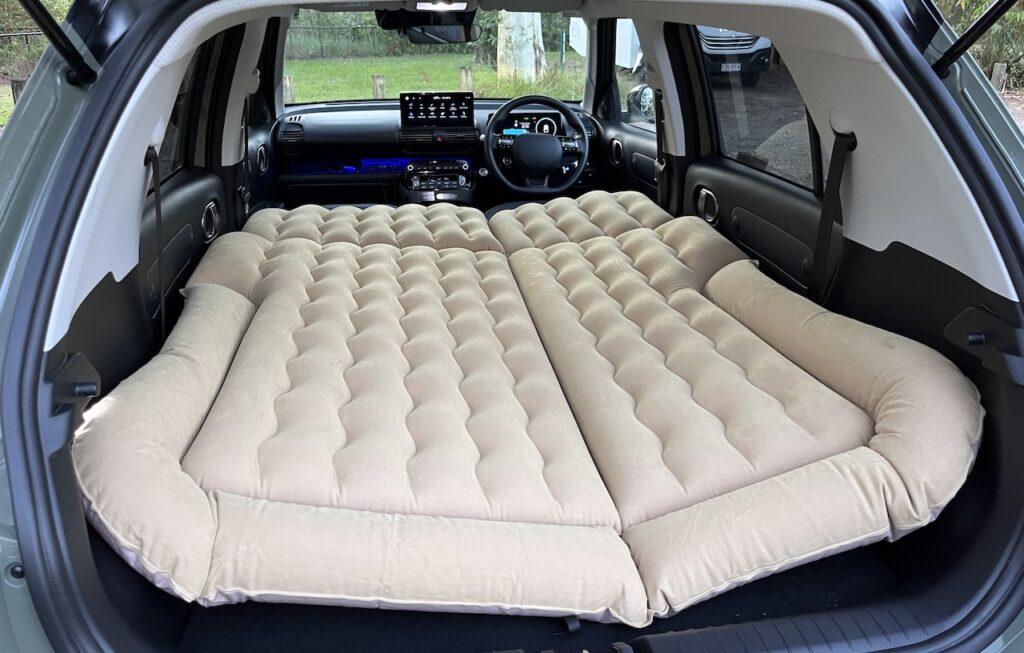
As I’d be sleep testing in numerous EVs, I bought a generic inflatable mattress that marketed itself as able to fit “most SUVs”.
I found one on Bunnings’ online store costing $40 delivered – a Weisshorn Car Mattress 175cmx130cm in beige, since you were wondering. It’s very much a Made in China special, but proved sufficient, reasonably comfortable and didn’t deflate overnight.
Importantly, you can inflate individual segments of this mattress depending on your EV’s dimensions. The Hyundai Inster being quite compact meant I only partially filled some air chambers so it could fit.
4. Check your EV’s internal power point or buy a V2L adapter
One of the joys of EV camping is using the Vehicle-to-Load (V2L) feature where fitted.
This is where the EV’s high voltage battery is used to power external devices using a standard domestic three-pin plug.
Think coffee machine, kettle, toaster, small fridge, projector or, very importantly, the air pump to inflate the mattress. You can charge your electric bike too.
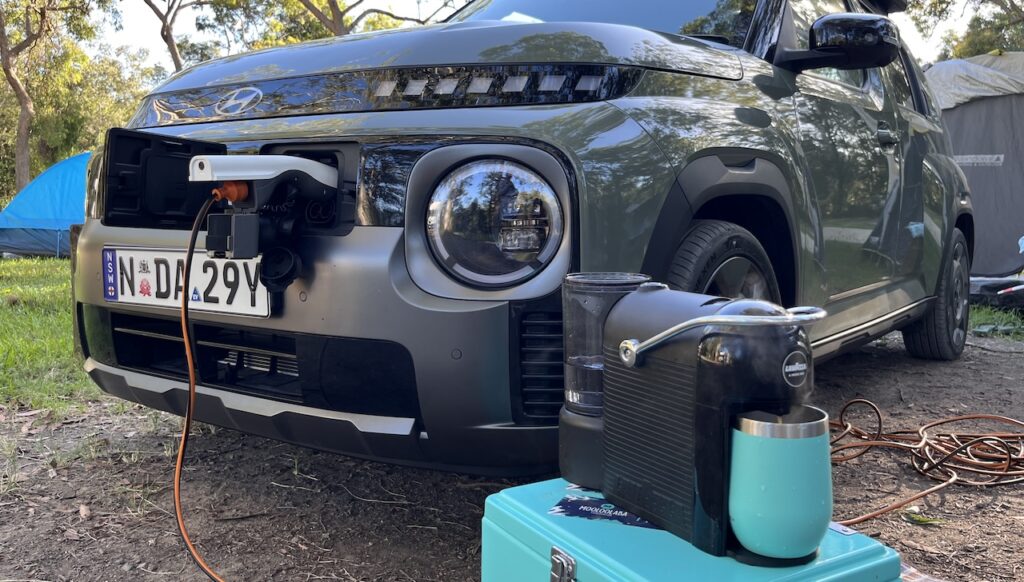
And no need for gas stoves, either. If you’ve space, why not take an air fryer, small electric oven or even the microwave? Quick eats, if not very traditional camping.
Word of warning. Test your V2L works before heading off camping. For an as-yet unknown reason, our Inster’s internal power socket refused to deliver power.
Thankfully, we’d brought a V2L adapter which slots into the car’s charging socket. It’s simple to plug your appliances directly into this, such as our Nespresso machine (above).
5. Book a powered campsite if you plan on staying a few nights
Here’s a plan. If the camp site or caravan park offers powered sites, you could pick one of these and AC charge your EV during your stay.
If using V2L, your EV is basically a mobile power bank during your stay.
No range anxiety this way, and if you’re staying a few days, chances are you’ll head for home with a full battery.
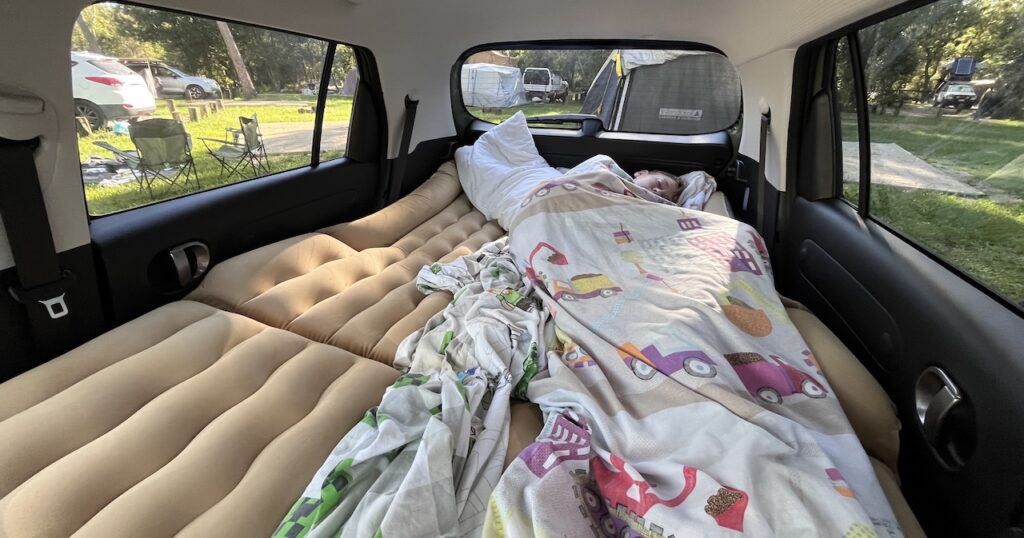
While my camping tests were one night only affairs, if you’re planning longer car-sleeping trips, investing in a tailgate tent buys more covered space for food preparation and relaxing.
But you’ll be carrying more, and the set-up time robs some of the convenience of simple car sleeping.
6. Try to set up camp away from others
Not always possible, but in my experience, being away from others makes for a better night’s snooze.
Unless you have window privacy screens (a faff to put up), the light from other camp setups / utilities blocks can disturb your sleep.
Plus it doesn’t feel very private having others stroll past a car while you’re trying to sleep, even if your window tints are good.
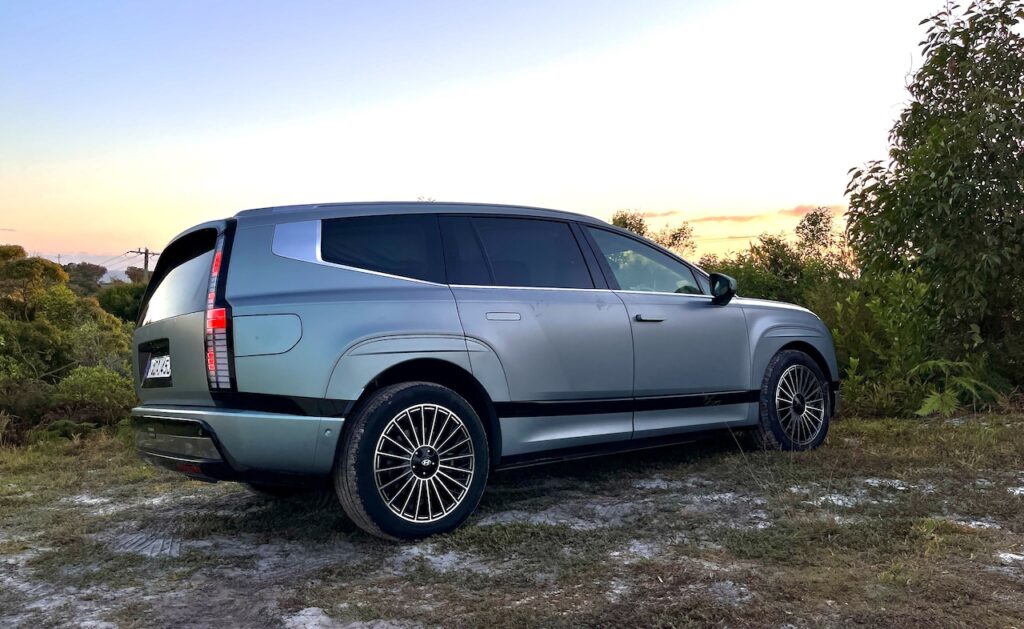
If you are lumbered in close quarters beside others, good news is we found late-night camp fire chats, crying babies, drunken parties and doof doof music were largely kept out due to cars being far better sealed and soundproofed than tents.
7. Proper preparation prevents problems
Here are a few extra nuggets I learned.
Do a dry run of your car camping setup before you set off. Make sure you know how to quickly and easily fold seats flat – you don’t want to be doing this for the first time when it’s dark.
For the Hyundai Ioniq 9 the two rear rows of seats folded easily, and I moved the front seats as far forward as possible. Bringing a few pillows greatly increases comfort.
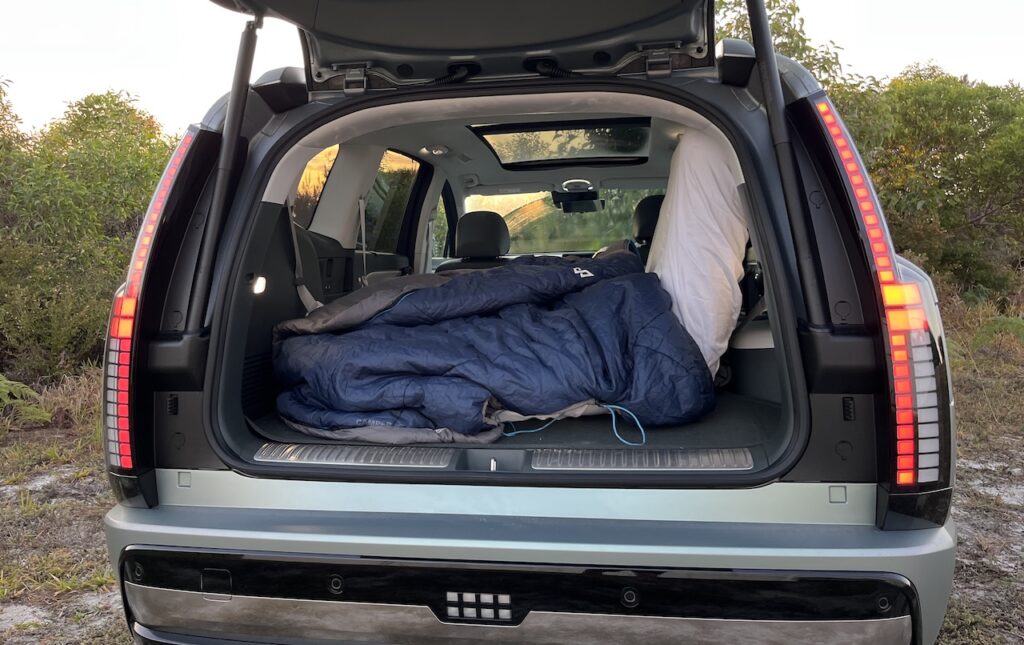
The little Inster Cross (but not the normal Inster) has front seats which fold completely flat to allow fitting that blow-up mattress.
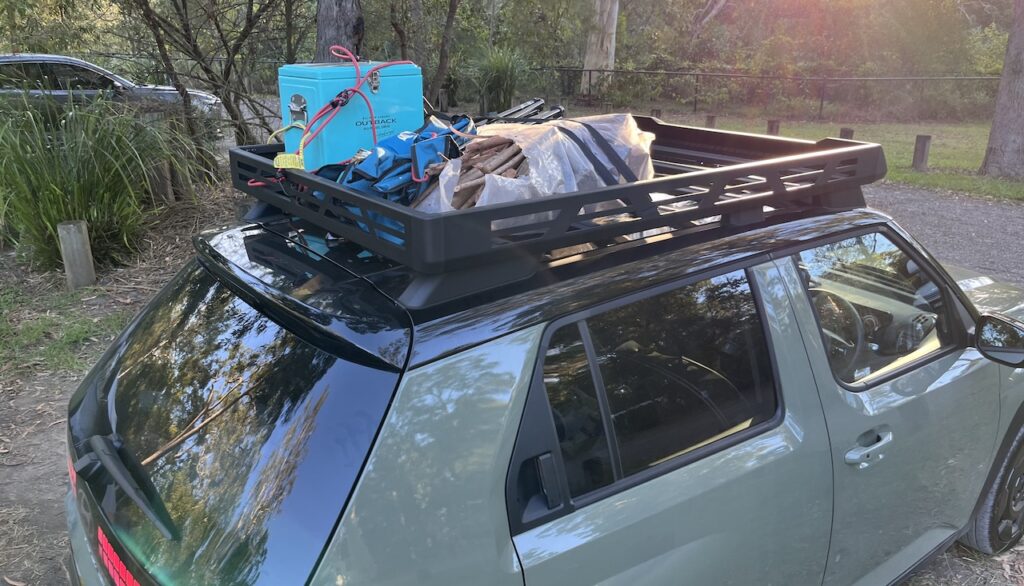
A roof basket, as fitted to the Inster Cross, proves damn useful. Carrying firewood, camp chairs and fishing rods up here rather than in the car is far more civilised.
A lockable roof box would be even better to store your things while sleeping with seats folded. However we managed to get plenty of kit in the cars’ under-boot storage and in the footwells.
Finally, if your EV has a panoramic glass roof, try to sort a camp spot with a clear view overhead.
If Mother Nature is kind, you’ll get the most spectacular star show from the comfort of your car hotel.

Try driving 700 kilometers off road, then camp for 5 days and drive back.
Real camping
Imagine getting caught behind a bushfire in a limited range EV. Or having to make a d-tour, or drive back 100kms due to a closed track or wrong track etc.
Unfortunately this article is either sarcasm, or clueless with the author obviously having no real life experience with camping in Australia.
I’m not anti EV, and I own a Tesla for city driving, but have a Prado for actual camping and long journeys.
Hi again Stefan. A Prado is indeed excellent for “actual” camping and long journeys, as you state. But that wasn’t the purpose of this article.
Just a little nugget here, as you mention bushfires. Combustion vehicles need oxygen. In extreme bushfire situations, through dense smoke, a combustion vehicle can be starved of oxygen, dramatically reducing power or stopping altogether. Not ideal when you need to retreat quickly. It can and has cost people their lives.
An EV doesn’t suffer in this way as it doesn’t need oxygen to drive. If I was in a bushfire scenario and had the choice between your Prado and Tesla for a quick escape, I’m hopping in the Tesla.
700km off-road may be “real” camping, but who is doing that in an EV?! Your example is not the only form of camping. You can go camping 50km from your house, as I did. For young kids who perhaps don’t want a 700km 5 day road trip, introducing them to camping as I did is better than them not doing it all, can we agree?
This wasn’t an article on how to go deep bush camping in a 4×4. It’s about some hopefully helpful tips for those who may want to try camping in an EV for the first time.
Not sure whether this is sarcasm. Camping with an Inster? Book a powered site? I think if you never done any camping you shouldn’t be telling others about camping mate. The vast majority of campsites are in a beautiful spot away from people, and with no power. You’re confusing caravan sites, with camping sites. These are often in less attractive spots, more expensive, noisier, and you’ll be amongst ugly caravans not tents.
Thanks Stefan. But this wasn’t an article on how to go deep bush camping in a 4×4. It’s about some hopefully helpful tips for those who may want to try camping/sleeping in an EV for the first time. That can be at a caravan site, camp site, car park at a music festival, whatever. Even in your back garden to give the kids a taste of car sleeping.
If you check out the lead image in the article, that’s where we camped. You may not decree it a campsite (although it’s advertised by QLD Parks as Coochin Creek camping and day-use area), but there wasn’t a single caravan there.
Was it as remote as the most beautiful camp spots in Australia? It was not. But to suggest people shouldn’t camp at such places because it doesn’t meet your high standards is a bit pompous. You may not have enjoyed it, but our family did.